

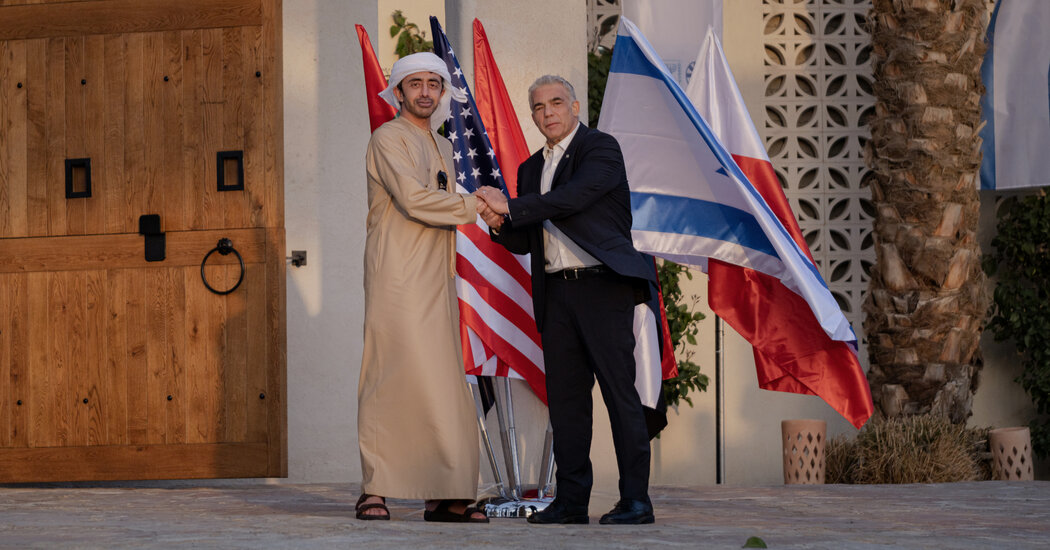
SDE BOKER, Israel — Israel was hosting four Arab foreign ministers and the U.S. secretary of state, Antony J. Blinken, on Monday in a groundbreaking summit that reflects how Israel has cemented its partnerships with parts of the Arab world.
As the first diplomatic meeting to gather so many Arab leaders on Israeli soil, the summit highlights a major realignment of Middle Eastern alliances that is driven by shared fears of a nuclear Iran; mutual concerns about the United States’ receding presence in the Middle East; a desire for better economic, military and business ties; and a dwindling commitment to Palestinian statehood by some Arab leaders.
While polling suggests that most Arabs across the Middle East oppose normalizing ties with Israel before the creation of a Palestinian state, the summit suggests that the participating Arab governments see the rewards of working with Israel outweighing the potential cost of disappointing public opinion.
Early discussions between the ministers on Sunday night and Monday morning centered on how to create a regional security infrastructure to defend against shared threats, including Iran, and how to keep the U.S. engaged in the region, two Israeli foreign ministry officials said. The ministers were also said to have discussed food security in the region, a concern heightened by Russia’s invasion of Ukraine because both of those nations are major grain suppliers to countries such as Egypt.
But a terrorist attack that killed two people on Sunday night in northern Israel, just as the ministers were gathering in the south, was a reminder of how Israel’s acceptance by some Arab states has done little to resolve its primary challenge: the conflict with Palestinians.
The summit is taking place in Sde Boker, a small desert town in southern Israel that was the final home of David Ben-Gurion, Israel’s first prime minister. The Israeli foreign minister, Yair Lapid, who organized the conference, arrived on Sunday afternoon, along with the foreign ministers of Bahrain, Morocco and the United Arab Emirates — which all normalized diplomatic ties with Israel in 2020 — and Egypt, which was the first Arab state to form diplomatic relations with Israel, in 1979.
The meetings provide a forum to discuss disagreements and shared concerns about the war in Ukraine and give Mr. Blinken a chance to encourage Washington’s Middle Eastern allies to align with efforts to isolate Russia.
Though the U.S. helped Israel broker the deals with the Bahrain, Morocco and the U.A.E., the summit was an indication that Israel can now itself act as a public conduit between Washington and some Arab countries.
By hosting, Israel will bring together Mr. Blinken and his Emirati counterpart, Abdullah bin Zayed Al Nahyan, at a time of friction between their countries over Russia’s invasion of Ukraine. The United Arab Emirates has so far dodged American demands to increase its oil production to help American allies find alternatives to Russian gas.
The foreign ministers meet as American-backed efforts to secure a new nuclear deal with Iran reach a climax. The meeting will give participants the chance to express concerns to Mr. Blinken about aspects of the proposed deal that they deem too lenient.
It also gives the Emirates and Bahrain an opportunity to encourage a distracted Washington to play a more active role in the region — a demand that they consider particularly urgent after recent attacks on Emirati and Saudi infrastructure by an Iranian-backed militia in Yemen that is fighting Saudi-led forces.
Analysts expect the participants to discuss how to limit the likelihood of a spasm of violence between Israelis and Palestinians this year, when tensions are expected to rise because of the rare overlap of Ramadan, Passover and Easter.
But there has been no reference in the buildup to the summit to any kind of renewed Israeli-Palestinian peace negotiations, a sign of how the Palestinian cause no longer has the same resonance for the Arab attendees.
Small groups of protesters, standing on a hill opposite the hotel where the summit was being held on Monday morning, attempted to draw attention to the Palestinian problem. One group held both a Palestinian and an Israeli flag. Another held a banner that said: “Go home.”
24World Media does not take any responsibility of the information you see on this page. The content this page contains is from independent third-party content provider. If you have any concerns regarding the content, please free to write us here: contact@24worldmedia.com

The Biden administration on Wednesday canceled...
Every family has its archetypes, so here’s...
On March 7, 2024,1 Dr. Naomi Wolf sounded an...
There are many benefits to buying and consuming...
On a December morning in central London, more...
In the 10 years since the drugmaker Gilead...

Bill Harris: Omega-3 – A Simple Way to Lower Your Risk of Disease


Chasing a hockey dream together: How Luke and Sophia Kunin make the first NHL-PWHL marriage work

Why Constipation Is on the Rise

‘To the Future’: Saudi Arabia Spends Big to Become an A.I. Superpower

Antidepressants: What to Know About Uses and Side Effects

Is Eating Eggshells Beneficial?

How hockey helped make J.J. McCarthy one of NFL Draft’s most intriguing prospects

Aspartame Classified as 'Possibly Carcinogenic'

Why You Want More Carbon Dioxide

Mark Clattenburg: The celebrity referee turned PGMOL agitator… via Gladiators

Everton Is Back on Market as Deal With 777 Partners Falters