

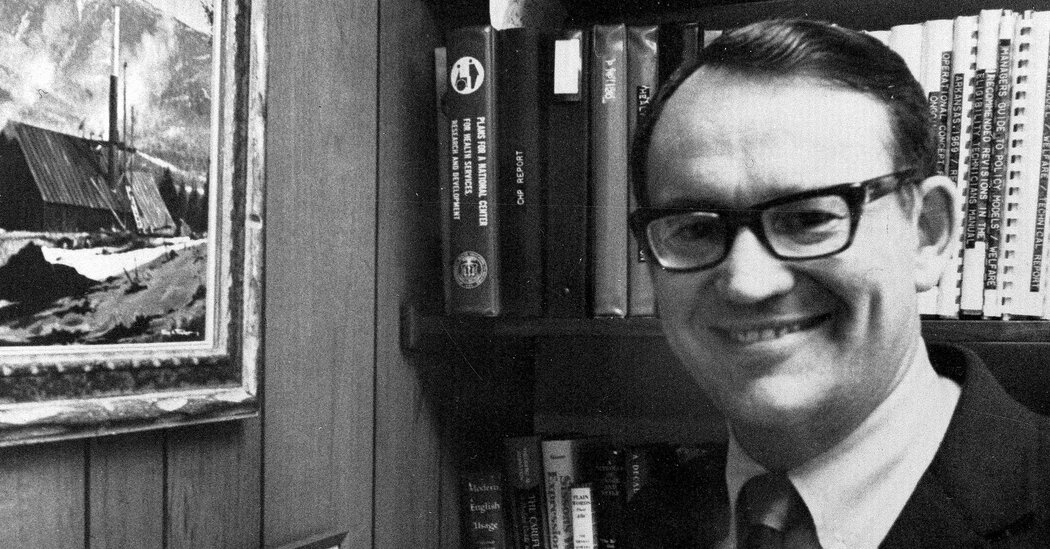
In the 1960s, while still working for the American Rehabilitation Foundation, Dr. Ellwood formed a health policy research group called Interstudy, which explored ways to apply business management techniques to improve health care and cut costs. It set up an H.M.O. that years later became United Health Group, now one of the nation’s largest health companies.
In the early 1970s, Dr. Ellwood, having given up his medical career, moved to Wyoming, got into real estate and founded the Jackson Hole Group — a cohort of doctors, economists, academics and policymakers who met at his home periodically for decades to talk about new health care strategies.
The group produced many reports, but its most notable was used by Bill Clinton in his 1992 presidential campaign, when he pledged to reform a health care system of runaway costs and uninsured millions. After Mr. Clinton’s election, Dr. Ellwood, the economist Alain C. Enthoven and others devised the blueprint for the administration’s “managed competition” health reform proposal.
It would have banded businesses and individuals into cooperatives to buy insurance from partnerships of doctors, hospitals and insurers competing for the business, and it would have covered almost all uninsured Americans. The plan, shepherded by Hillary Clinton, failed in 1994, but by then Dr. Ellwood and his colleagues had distanced themselves from the plan over conflicts about the levels of regulation it would have imposed.
Dr. Ellwood, who lived in Bellingham, north of Seattle, retired as president of the Jackson Hole Group in 2002. He and his first wife, Elizabeth Ann (Schwenk) Ellwood, had three children, Deborah, Cynthia and David. They divorced in 1990 and Elizabeth Ann later died. In 2000, he married Barbara Winch. In addition to his wife, Dr. Ellwood is survived by his three children and five grandchildren.
In later years he championed what he called “outcomes management” — a national database to show how the treatment of patients actually works out. Without such measures, he argued, health care providers and policymakers had no way of knowing whether care was being compromised to cut costs, and no way to evaluate proposals for reforms.
24World Media does not take any responsibility of the information you see on this page. The content this page contains is from independent third-party content provider. If you have any concerns regarding the content, please free to write us here: contact@24worldmedia.com

The Biden administration on Wednesday canceled...
Every family has its archetypes, so here’s...
On March 7, 2024,1 Dr. Naomi Wolf sounded an...
There are many benefits to buying and consuming...
On a December morning in central London, more...
In the 10 years since the drugmaker Gilead...

Bill Harris: Omega-3 – A Simple Way to Lower Your Risk of Disease

Chasing a hockey dream together: How Luke and Sophia Kunin make the first NHL-PWHL marriage work

Why Constipation Is on the Rise

‘To the Future’: Saudi Arabia Spends Big to Become an A.I. Superpower

Antidepressants: What to Know About Uses and Side Effects

Is Eating Eggshells Beneficial?

How hockey helped make J.J. McCarthy one of NFL Draft’s most intriguing prospects

Aspartame Classified as 'Possibly Carcinogenic'

Why You Want More Carbon Dioxide

Mark Clattenburg: The celebrity referee turned PGMOL agitator… via Gladiators

Everton Is Back on Market as Deal With 777 Partners Falters