

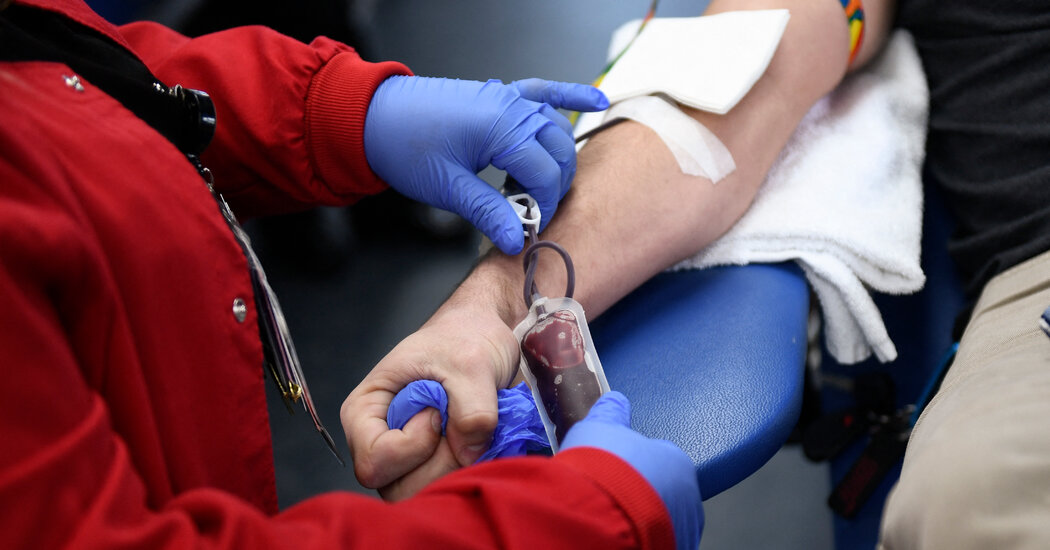
The Food and Drug Administration announced on Thursday that it had formally ended the agency’s wide-ranging prohibition on blood donations from gay and bisexual men, a longstanding policy that had been denounced as discriminatory.
Instead, the F.D.A. is finalizing guidance that includes a questionnaire for all donors that is aimed at learning about their recent sexual activity. The more targeted questions will focus on whether someone has had new or multiple sex partners and anal sex in the last three months.
Potential donors who had recent sex with multiple partners or anal sex under those screening criteria would still be turned away.
The revised policy would also preclude blood donations from people taking oral PrEP to prevent H.I.V. infection, a restriction the agency said was designed to avoid false-negative results during blood screening.
In the revised policy the F.D.A. took its cues from Canada and the United Kingdom, which adopted similar approaches. The U.S. agency has been working on the change for months and said it also reviewed data from other nations and from a U.S. study examining this method.
Blood donations are sorely needed. They fell during and after the pandemic with the decrease in school- and office-based blood drives.
The old rules were far more restrictive in screening out gay or bisexual men. The update allows blood donation companies to use a more evidence-based way to reduce the risk of H.I.V. transmission while also maximizing donations.
“This shift toward individual donor assessments prioritizes the safety of America’s blood supply while treating all donors with the fairness and respect they deserve,” said Kate Fry, the chief executive of America’s Blood Centers, which represents independent blood centers that supply 60 percent of the nation’s donations.
GLAAD, an L.G.B.T.Q. advocacy group, applauded the change as an end to “a dark and discriminatory past rooted in fear and homophobia.” But the organization criticized the F.D.A.’s decision to turn away donors taking PrEP medications, saying the measure would add “unnecessary stigma.”
“The bias embedded into this policy may, in fact, cost lives,” GLAAD said in a statement Thursday.
The agency said that PrEP drugs were effective in reducing the spread of H.I.V. through sexual contact, but warned that blood transfusions could carry a higher risk of infection.
“Although H.I.V. is not transmitted sexually by individuals with undetectable viral levels, this does not apply to transfusion transmission of H.I.V. because a blood transfusion is administered intravenously, and a transfusion involves a large volume of blood compared to exposure with sexual contact,” the F.D.A. said in a news release on Thursday.
Vitalent, a blood donation company, has said that it would adopt the agency’s revised screening rules by updating its donor history questionnaire and computer systems and by training staff.
24World Media does not take any responsibility of the information you see on this page. The content this page contains is from independent third-party content provider. If you have any concerns regarding the content, please free to write us here: contact@24worldmedia.com

The Biden administration on Wednesday canceled...
Every family has its archetypes, so here’s...
On March 7, 2024,1 Dr. Naomi Wolf sounded an...
There are many benefits to buying and consuming...
On a December morning in central London, more...
In the 10 years since the drugmaker Gilead...
Bill Harris: Omega-3 – A Simple Way to Lower Your Risk of Disease

Chasing a hockey dream together: How Luke and Sophia Kunin make the first NHL-PWHL marriage work

Why Constipation Is on the Rise

‘To the Future’: Saudi Arabia Spends Big to Become an A.I. Superpower
Antidepressants: What to Know About Uses and Side Effects

Is Eating Eggshells Beneficial?

How hockey helped make J.J. McCarthy one of NFL Draft’s most intriguing prospects
Aspartame Classified as 'Possibly Carcinogenic'

Why You Want More Carbon Dioxide

Mark Clattenburg: The celebrity referee turned PGMOL agitator… via Gladiators

Everton Is Back on Market as Deal With 777 Partners Falters