

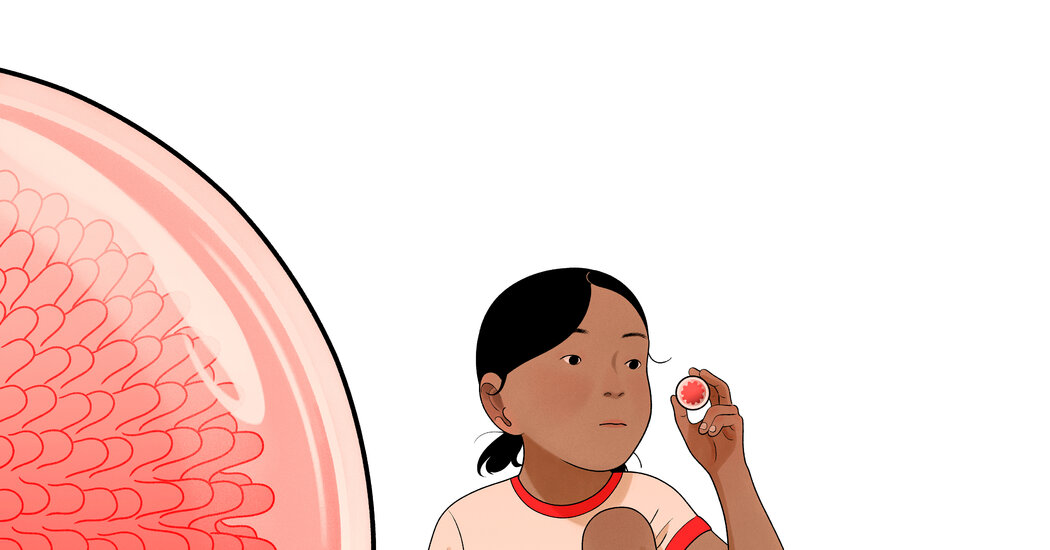
As the virus spread, more mutations sprang up, giving rise to even more transmissible variants. First came Alpha, which was about 50 percent more infectious than the original virus, and soon Delta, which was, in turn, roughly 50 percent more infectious than Alpha.
“Now we’re basically in a Delta pandemic,” said Robert Garry, a virologist at Tulane University. “So another surge, another spread of a slightly better variant.”
Although some experts were surprised to see the hyperinfectious variant, which has more than a dozen notable mutations, emerge so quickly, the appearance of more transmissible variants is textbook viral evolution.
“It’s hard to imagine that the virus is going to pop into a new species perfectly formed for that species,” said Andrew Read, an evolutionary microbiologist at Penn State University. “It’s bound to do some adaptation.”
But scientists don’t expect this process to continue forever.
There are likely to be some basic biological limits on just how infectious a particular virus can become, based on its intrinsic properties. Viruses that are well adapted to humans, such as measles and the seasonal influenza, are not constantly becoming more infectious, Dr. Bloom noted.
It is not entirely clear what the constraints on transmissibility are, he added, but at the very least, the new coronavirus cannot replicate infinitely fast or travel infinitely far.
“Transmission requires one person to somehow exhale or cough or breathe out the virus, and it to land in someone else’s airway and infect them,” Dr. Bloom said. “There are just limits to that process. It’s never going to be the case that I’m sitting here in my office, and I’m giving it to someone on the other side of Seattle, right?”
24World Media does not take any responsibility of the information you see on this page. The content this page contains is from independent third-party content provider. If you have any concerns regarding the content, please free to write us here: contact@24worldmedia.com

The Biden administration on Wednesday canceled...
Every family has its archetypes, so here’s...
On March 7, 2024,1 Dr. Naomi Wolf sounded an...
There are many benefits to buying and consuming...
On a December morning in central London, more...
In the 10 years since the drugmaker Gilead...

Bill Harris: Omega-3 – A Simple Way to Lower Your Risk of Disease

Chasing a hockey dream together: How Luke and Sophia Kunin make the first NHL-PWHL marriage work

Why Constipation Is on the Rise

‘To the Future’: Saudi Arabia Spends Big to Become an A.I. Superpower

Antidepressants: What to Know About Uses and Side Effects

Is Eating Eggshells Beneficial?

How hockey helped make J.J. McCarthy one of NFL Draft’s most intriguing prospects

Aspartame Classified as 'Possibly Carcinogenic'

Why You Want More Carbon Dioxide

Mark Clattenburg: The celebrity referee turned PGMOL agitator… via Gladiators

Everton Is Back on Market as Deal With 777 Partners Falters