

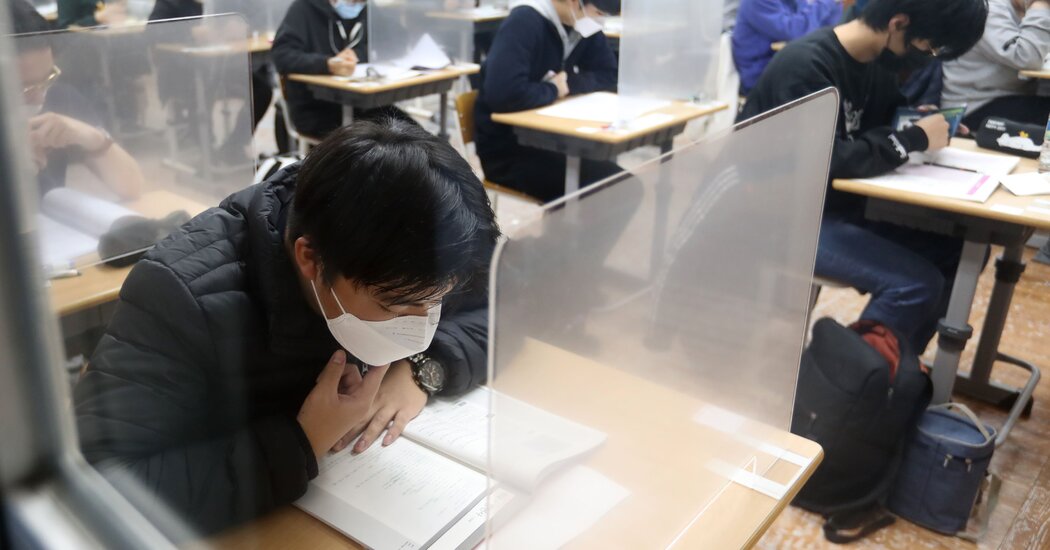
South Korea said on Thursday that it would hospitalize even asymptomatic high school seniors with Covid if they are taking the country’s high-stakes college entrance exam later this month, as the drive to vaccinate younger people lags and teenagers account for nearly a quarter of all Covid patients.
The decision comes as South Korea experiences rising caseloads again. The annual nine-hour exam is seen as critical in determining students’ futures, and many of those taking the test have prepared for it since kindergarten.
But because the test must be taken under supervision, the government has decided that those taking the Nov. 18 exam who test positive for the virus will have to do so from a hospital or quarantine facility, even if they show no symptoms.
“We are preparing for the situation in which people may take the social-distancing rules less seriously as the country eases restrictions,” the Education Ministry said in a statement on Thursday, two weeks before half a million students will hunker down for the exams.
As South Korea begins its phased easing of Covid restrictions, the risk of infections will “only increase,” particularly among younger people, who have lower vaccination rates, Son Young-rae, a Health Ministry spokesman, said on Wednesday.
Only about 0.2 percent of people ages 17 and under, including those not yet eligible for shots, were fully vaccinated as of last week, according to data released by the Health Ministry on Oct. 27. South Korea began vaccinating those ages 16 to 17 on Oct. 18 and those ages 12 to 15 on Nov. 1.
Since easing restrictions on Monday, the country has recorded more than 2,000 cases a day on average in the past week, an increase that officials are watching closely, Mr. Son said. More than 24 percent of Covid patients are teenagers, the interior and safety minister, Jeon Hae-cheol, said on Wednesday.
The easing of restrictions, including the lifting of all limits on the operating hours of restaurants and bars, was a relief for many small-business owners, but it has also stirred fears about the possibility of outbreaks larger than the country has yet seen.
“It feels like watching an approaching tsunami from a small boat,” said Dr. Joong-sik Eom, professor of infectious diseases who has treated Covid patients at Gachon University Gil Hospital in Incheon, in a Facebook post on Monday.
As part of the phased reopening plan, the Education Ministry said that it would fully reopen elementary, middle and high schools nationwide on Nov. 22. But it said that it would make an exemption for high schools ahead of the college entrance exams, switching all instruction to remote learning starting on Nov. 11, a week before the exams, until the exams are over.
For test takers with Covid, the ministry said that it had reserved 244 hospital beds. It said that it would also closely monitor cases and adherence to Covid rules at 320 cram schools nationwide.
24World Media does not take any responsibility of the information you see on this page. The content this page contains is from independent third-party content provider. If you have any concerns regarding the content, please free to write us here: contact@24worldmedia.com

The Biden administration on Wednesday canceled...
Every family has its archetypes, so here’s...
On March 7, 2024,1 Dr. Naomi Wolf sounded an...
There are many benefits to buying and consuming...
On a December morning in central London, more...
In the 10 years since the drugmaker Gilead...
Bill Harris: Omega-3 – A Simple Way to Lower Your Risk of Disease
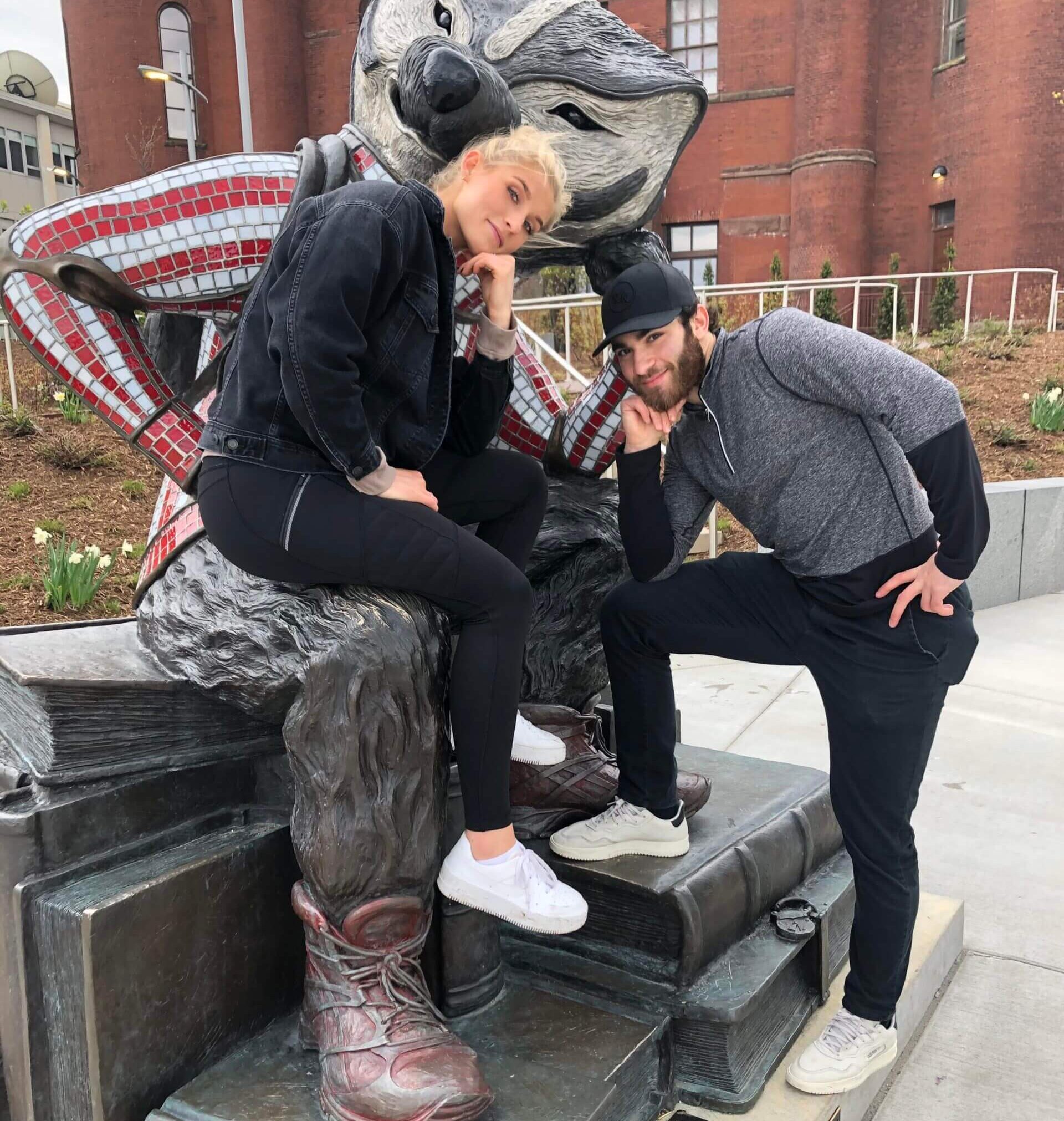
Chasing a hockey dream together: How Luke and Sophia Kunin make the first NHL-PWHL marriage work

Why Constipation Is on the Rise

‘To the Future’: Saudi Arabia Spends Big to Become an A.I. Superpower
Antidepressants: What to Know About Uses and Side Effects

Is Eating Eggshells Beneficial?

How hockey helped make J.J. McCarthy one of NFL Draft’s most intriguing prospects

Aspartame Classified as 'Possibly Carcinogenic'
Why You Want More Carbon Dioxide

Mark Clattenburg: The celebrity referee turned PGMOL agitator… via Gladiators
Everton Is Back on Market as Deal With 777 Partners Falters