

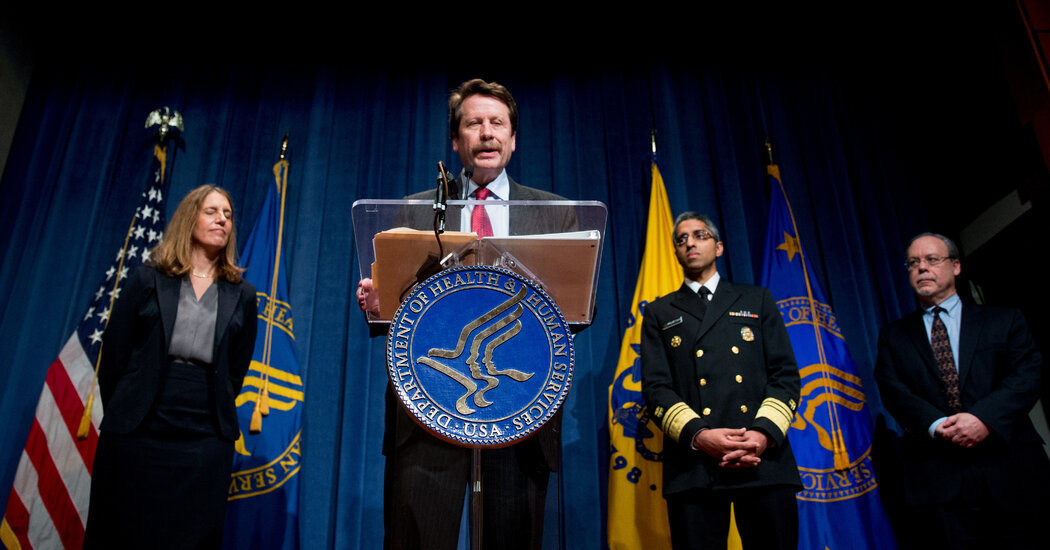
“The truth of the matter is industry develops drugs — you have to work with industry. The issue is disclosure in publication,” said Ellen V. Sigal, the founder and chairwoman of the nonprofit Friends of Cancer Research, which accepts industry funding. “Rob has done many, many clinical trials with industry, but he has not been a pawn of industry. He’s completely committed to transparency, integrity and science.”
Dr. Aaron S. Kesselheim, who served on the F.D.A. advisory panel that considered the Alzheimer’s drug and resigned from the committee after it was approved, said Dr. Califf’s background running clinical trials would be valuable for leading the agency.
“I don’t think it’s necessarily disqualifying,” said Dr. Kesselheim, a professor of medicine at Harvard Medical School and Brigham and Women’s Hospital. “I think the fact that he worked for such a long time in clinical trials demonstrates that he has expertise in understanding what goes into a good clinical trial. Hopefully, he can bring that into his role as an F.D.A. commissioner.”
But Dr. Kesselheim objected to Dr. Califf’s efforts, when he was the commissioner, to allow drug companies to advertise off-label uses for their products, noting that patients can be endangered by drugs that are prescribed for uses that the F.D.A. has not approved. “That to me is a red flag,” Dr. Kesselheim said. “Hopefully, he’s moved past that as an idea, because it would be a terrible idea.”
During his first tenure at the agency, Dr. Califf focused on modernizing the collection and use of electronic health data to answer questions about drugs and medical devices that could not be gleaned from clinical trials.
He also sought to increase the use of “real-world evidence” — case studies and individual patient experiences — to inform regulatory decisions. Some public health experts fear that relying on data outside of randomized clinical trials endangers patients; Dr. Califf believes there is room for both approaches.
His willingness to consider such data caused controversy in 2016, when the Food and Drug Administration overruled its experts to approve a new drug for treatment of a rare, fatal muscle disease, despite lack of evidence that it worked.
24World Media does not take any responsibility of the information you see on this page. The content this page contains is from independent third-party content provider. If you have any concerns regarding the content, please free to write us here: contact@24worldmedia.com

The Biden administration on Wednesday canceled...
Every family has its archetypes, so here’s...
On March 7, 2024,1 Dr. Naomi Wolf sounded an...
There are many benefits to buying and consuming...
On a December morning in central London, more...
In the 10 years since the drugmaker Gilead...

Bill Harris: Omega-3 – A Simple Way to Lower Your Risk of Disease


Chasing a hockey dream together: How Luke and Sophia Kunin make the first NHL-PWHL marriage work

Why Constipation Is on the Rise

‘To the Future’: Saudi Arabia Spends Big to Become an A.I. Superpower
Antidepressants: What to Know About Uses and Side Effects

Is Eating Eggshells Beneficial?

How hockey helped make J.J. McCarthy one of NFL Draft’s most intriguing prospects

Aspartame Classified as 'Possibly Carcinogenic'

Why You Want More Carbon Dioxide

Mark Clattenburg: The celebrity referee turned PGMOL agitator… via Gladiators

Everton Is Back on Market as Deal With 777 Partners Falters