

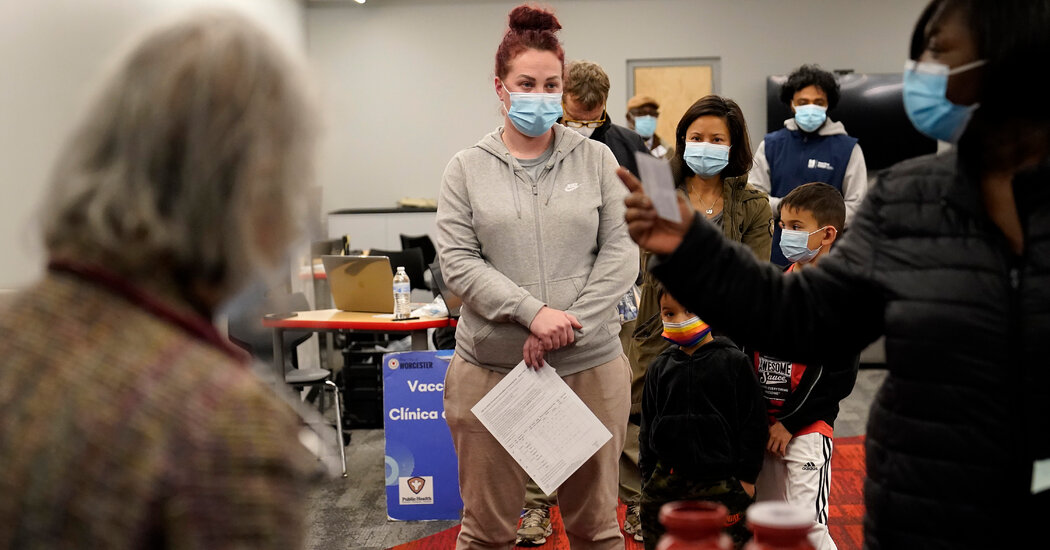
The Centers for Disease Control and Prevention, which millions of Americans rely on for up-to-date information on vaccination rates in their communities, recently acknowledged that its data might overestimate the number of people who have received first doses while underestimating the number who have received booster shots.
The acknowledgment was easy to miss, tucked into footnotes at the bottom of the vaccination tracking page on the C.D.C. website. It said that, in light of the possible error, the agency would cap its estimates of vaccination rates at 95 percent. Previously, it had capped its estimates at 99.9 percent and, for example, showed a 99.9 percent national vaccination rate for people 65 and older, which experts said was clearly inaccurate.
The C.D.C.’s data on vaccination rates are still considered to be reliable, especially with regard to the number of fully vaccinated Americans, experts say.
The main reason for the discrepancies is that state and county data, which the C.D.C. relies on to compile its statistics, does not always properly link the record of people’s booster shots to the records of their initial vaccinations. When the two are not connected, the booster is recorded as though it were a first dose given to a previously unvaccinated person.
This can happen when people go to a different location for a booster shot than they did for their original series of injections. That often occurs when people move, or the place they received their first doses doesn’t exist anymore, as is the case with many government-sponsored mass vaccination sites that closed after a few months. Sometimes a different location for a booster is chosen simply because it’s more convenient.
Data reported to the C.D.C. is stripped of personal information, which makes it difficult to spot and correct these sorts of errors.
“Even with the high-quality data C.D.C. receives from jurisdictions and federal entities, there are limits to how C.D.C. can analyze those data,” the agency said in one of its footnotes. The note added that people receiving boosters at a different location was “just one example of how C.D.C.’s data may overestimate first doses and underestimate booster doses.”
A broader reporting challenge is that methodology varies from state to state. Some, for instance, record prisoners in the county where they are incarcerated, while others record them in the county where they lived before. These practices do not always align with how the census counts prisoners — and the C.D.C. uses census counts as its denominators in calculating vaccination rates.
Take Crowley County, Colo., as an example. The county is home to a state prison with capacity for nearly 1,900 people. Colorado counts those prisoners at their last legal address, not in Crowley County (unless, of course, they lived in Crowley before they were incarcerated).
That means the state calculates the county’s vaccination rate by dividing the number of vaccinations by the number of residents excluding prisoners. But when Colorado reports its data to the C.D.C., the agency divides the number of vaccinations by the census count, which includes prisoners.
Given that the county has fewer than 6,000 residents, that change in the denominator makes a huge difference, yielding a vaccination rate of just over 20 percent in the C.D.C. data but close to 50 percent in Colorado’s data.
Amy Schoenfeld Walker and Danielle Ivory contributed reporting.
24World Media does not take any responsibility of the information you see on this page. The content this page contains is from independent third-party content provider. If you have any concerns regarding the content, please free to write us here: contact@24worldmedia.com

The Biden administration on Wednesday canceled...
Every family has its archetypes, so here’s...
On March 7, 2024,1 Dr. Naomi Wolf sounded an...
There are many benefits to buying and consuming...
On a December morning in central London, more...
In the 10 years since the drugmaker Gilead...

Bill Harris: Omega-3 – A Simple Way to Lower Your Risk of Disease

Chasing a hockey dream together: How Luke and Sophia Kunin make the first NHL-PWHL marriage work

Why Constipation Is on the Rise

‘To the Future’: Saudi Arabia Spends Big to Become an A.I. Superpower

Antidepressants: What to Know About Uses and Side Effects

Is Eating Eggshells Beneficial?

How hockey helped make J.J. McCarthy one of NFL Draft’s most intriguing prospects
Aspartame Classified as 'Possibly Carcinogenic'

Why You Want More Carbon Dioxide

Mark Clattenburg: The celebrity referee turned PGMOL agitator… via Gladiators

Everton Is Back on Market as Deal With 777 Partners Falters