

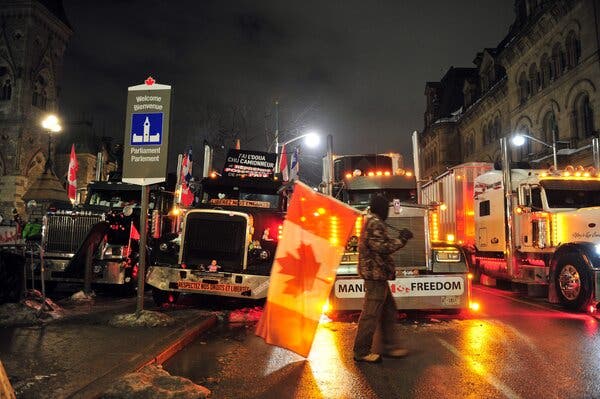
A new trucker blockade protesting pandemic restrictions snarled traffic at a third point along the Canadian and the United States border on Wednesday, putting more pressure on the automotive industry, which depends on the seamless movement of parts and components between the countries.
A barricade of trucks in Sarnia, Ontario, stalled traffic traveling on the only expressway route to a bridge into the United States.
That bridge was already swamped on Wednesday with traffic from the United States after it became the only alternative route to the Ambassador Bridge between Detroit and Windsor, Ontario, which was shut in the Canada-bound direction by a road blockade on Monday. The Sarnia bridge connects that city to Port Huron, Mich.
On Wednesday, Drew Dilkins, Sarnia’s mayor, said he would ask the federal government for assistance in dealing with the new blockade.
Because of parts supply issues related to the problems with the Sarnia bridge, the Stellantis minivan assembly plant in Windsor was forced to cut two shifts short Tuesday, said LouAnn Gosselin, a spokeswoman for the company. Production resumed Wednesday morning, she said, and the company was working with parts suppliers to prevent further shutdowns.
Truck protesters on Wednesday were also still interfering with another border crossing between the Western province of Alberta and Montana.
The three blockades came as the demonstrations in Canada’s capital of Ottawa — by loosely organized groups of truck drivers and protesters opposed to vaccination requirements for truckers crossing into Canada from the United States — continued to echo globally. In France, dozens of trucks and vehicles left the south of the country for Paris to vent their anger over their country’s vaccination policies.
The protests have also inspired copycat convoys in New Zealand and Australia. And there are talks of another in the works in the United States.
Far-right and anti-vaccine groups around the world have amplified the message of the Canadian protesters on social media, raising millions of dollars in online campaigns.
The main Facebook group for the French demonstrators has attracted more than 320,000 followers in just a few days. The movement calls itself “Convoi de la Liberté,” a direct translation of “Freedom Convoy,” the slogan for the Canadian movement.
In Ottawa, life continued to be disrupted by the presence of more than 400 trucks blocking roads. Residents got some relief on Tuesday night when the drivers of the trucks for the second night refrained from blasting their air horns, a form of protest that was enjoined by a court order on Monday afternoon.
Social media posts advertising a possible demonstration in downtown Toronto spurred police to block off roads surrounding the provincial legislature building on Wednesday morning, repeating precautions they took ahead of protests last weekend.
Although most Canadians support the public health measures that Canada has taken to combat the pandemic, the truck protesters have nonetheless tapped into fatigue with pandemic restrictions.
On Tuesday, Scott Moe, the conservative premier of Saskatchewan, who has voiced support for the protesters, announced that the province would end vaccination and testing requirements on Feb. 14. Indoor mask requirements will continue until the end of the month.
In Alberta, Premier Jason Kenney announced that the province’s vaccine passport program would end as of Wednesday, and that mask mandates in schools would be lifted next week.
Most Canadian trucking groups have condemned the convoys and blockades, and said that more than 90 percent of drivers were vaccinated. Despite protesters’ claims that the mandatory vaccination of truckers would lead to border disruptions and supply shortages, the Canadian government said that it has not seen any change in truck traffic on its border.
Ottawa’s police chief, who declared a state of emergency on Sunday, has vowed to end the protests but has said the city needs 1,800 more officers to do that. Mr. Trudeau said on Twitter that hundreds of Royal Canadian Mounted Police had been mobilized to support Ottawa police officers, and promised that the Canadian government and city would employ “whatever resources are needed to get the situation under control.”
24World Media does not take any responsibility of the information you see on this page. The content this page contains is from independent third-party content provider. If you have any concerns regarding the content, please free to write us here: contact@24worldmedia.com

The Biden administration on Wednesday canceled...
Every family has its archetypes, so here’s...
On March 7, 2024,1 Dr. Naomi Wolf sounded an...
There are many benefits to buying and consuming...
On a December morning in central London, more...
In the 10 years since the drugmaker Gilead...

Bill Harris: Omega-3 – A Simple Way to Lower Your Risk of Disease

Chasing a hockey dream together: How Luke and Sophia Kunin make the first NHL-PWHL marriage work

Why Constipation Is on the Rise

‘To the Future’: Saudi Arabia Spends Big to Become an A.I. Superpower

Antidepressants: What to Know About Uses and Side Effects

Is Eating Eggshells Beneficial?

How hockey helped make J.J. McCarthy one of NFL Draft’s most intriguing prospects
Aspartame Classified as 'Possibly Carcinogenic'

Why You Want More Carbon Dioxide

Mark Clattenburg: The celebrity referee turned PGMOL agitator… via Gladiators

Everton Is Back on Market as Deal With 777 Partners Falters