

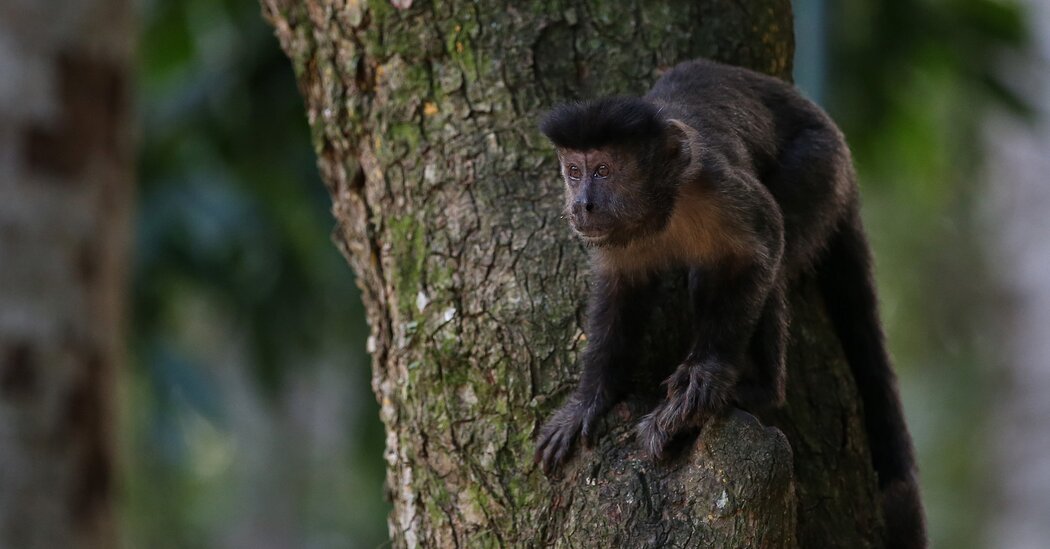
Monkeys are not to blame for the monkeypox outbreak that has triggered health alerts, including a national health emergency in the United States, as the viral disease has continued to spread, the World Health Organization said this week after reports of attacks against the animals in Brazil.
At least 10 monkeys were rescued last week in São José do Rio Preto in the Brazilian state of São Paulo after the authorities found signs they had been attacked or poisoned, out of fear of monkeypox transmission, according to the G1 news site in that country. Seven of the monkeys later died.
The police in São Paulo are investigating those cases and said the mistreatment of animals could be punishable by three months to one year in jail.
Despite the name, the risk of monkeypox transmission during this outbreak is centered on humans, not animals, Margaret Harris, a W.H.O. spokeswoman, said during a Tuesday news conference.
“What people need to know very clearly is the transmission we are seeing is happening between humans to humans,” she said. “It’s close-contact transmission. The concern should be about where it’s transmitting in the human population and what humans can do to protect themselves from getting it and transmitting it. They should certainly not be attacking any animals.”
The statement was prompted by a question at the news conference in Geneva about the recent monkey attacks in Brazil.
The virus was named after it was originally found in a group of laboratory monkeys in 1958 in Denmark, but rodents are thought to be the primary animal hosts for the virus, Ms. Harris said.
Some scientists and public health officials have called for a new name for the disease, citing racist overtones and stigmatization, but no official change has been announced. They say the current name could have “potentially devastating and stigmatizing effects” or erroneously link the virus solely to the African continent, when it is now an international crisis.
The W.H.O. is having ongoing conversations on what should be the right name for the virus, Ms. Harris said. She said an announcement would be coming soon.
“Any stigmatization of any person infected is going to increase the transmission,” Ms. Harris said. “Because if people are afraid of identifying themselves as being infected, then they will not get care and they will not take precautions and we will see more transmission.”
The monkeypox virus is primarily found in Central and West Africa, particularly in areas close to tropical rainforests — and rope squirrels, tree squirrels, Gambian pouched rats and dormice have all been identified as potential carriers.
People who get sick commonly experience a fever, headache, back and muscle aches, swollen lymph nodes, and exhaustion. A rash that looks like pimples or blisters is also common. Transmission occurs with close physical contact and most commonly spreads once symptoms have appeared, about six to 13 days after exposure. A majority of cases this year have been in young men, many of whom self-identify as men who have sex with men.
The United States declared a national health emergency this month over the monkeypox outbreak, with more than 10,000 confirmed cases nationwide according to the Centers for Disease Control and Prevention. The W.H.O. activated its highest level of alert for monkeypox in July, with the number of international confirmed cases rising to more than 31,000 so far.
Two vaccines originally developed for smallpox can help prevent monkeypox infections, with Jynneos considered the safer choice. Supplies in the United States, however, have been limited. People can be vaccinated after exposure to the virus to prevent the development of the disease.
Juliana Barbassa contributed translation.
24World Media does not take any responsibility of the information you see on this page. The content this page contains is from independent third-party content provider. If you have any concerns regarding the content, please free to write us here: contact@24worldmedia.com

The Biden administration on Wednesday canceled...
Every family has its archetypes, so here’s...
On March 7, 2024,1 Dr. Naomi Wolf sounded an...
There are many benefits to buying and consuming...
On a December morning in central London, more...
In the 10 years since the drugmaker Gilead...

Bill Harris: Omega-3 – A Simple Way to Lower Your Risk of Disease

Chasing a hockey dream together: How Luke and Sophia Kunin make the first NHL-PWHL marriage work

Why Constipation Is on the Rise

‘To the Future’: Saudi Arabia Spends Big to Become an A.I. Superpower

Antidepressants: What to Know About Uses and Side Effects

Is Eating Eggshells Beneficial?

How hockey helped make J.J. McCarthy one of NFL Draft’s most intriguing prospects

Aspartame Classified as 'Possibly Carcinogenic'

Why You Want More Carbon Dioxide

Mark Clattenburg: The celebrity referee turned PGMOL agitator… via Gladiators

Everton Is Back on Market as Deal With 777 Partners Falters