

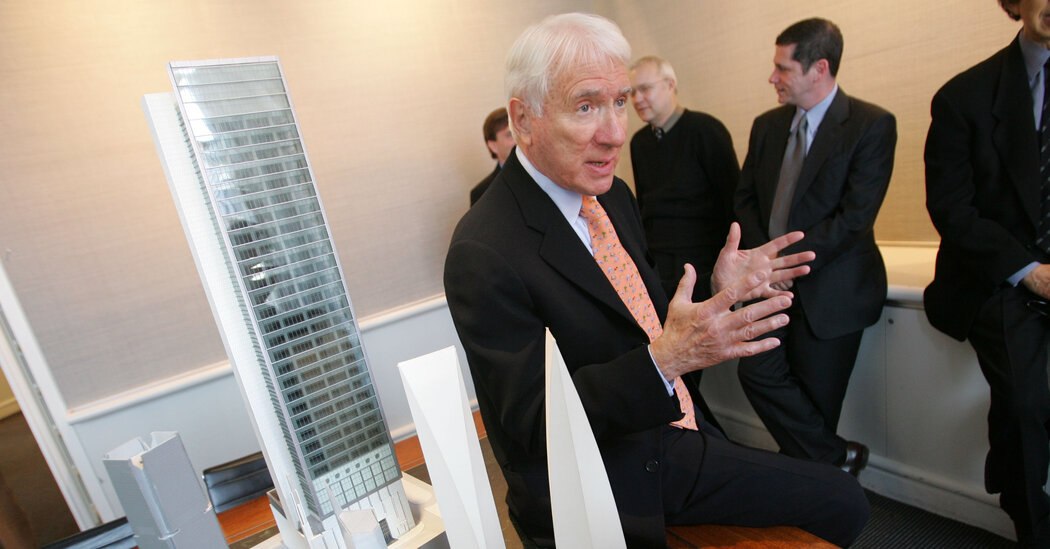
Mr. Kohn was then in charge of the New York office of John Carl Warnecke, a prominent architect based in San Francisco, and he recruited Mr. Pedersen to join him there. Mr. Kohn had previously persuaded Sheldon Fox, an architecture school classmate from the University of Pennsylvania, to join him at Warnecke. There, the three men set about trying to expand the firm’s presence on the East Coast.
But a lot of the work Mr. Kohn had hoped to generate didn’t materialize, and he decided he would be better off on his own. He persuaded Mr. Pedersen to join him as a design partner and Mr. Fox to oversee the firm’s business affairs, and the three went into business as Kohn Pedersen Fox at the depth of New York’s economic troubles in the 1970s.
“It was a frightening time,” Mr. Pedersen recalled. “We had about enough money to survive for three months. We even worried about the long-distance phone charges for all of Gene’s calls trying to get work.”
With the extroverted Mr. Kohn as impresario and the public face of the firm, the more reflective Mr. Pedersen at the drawing board, and Mr. Fox managing the business side, the three constituted an unusual but effective partnership between the commercial and the creative, and KPF prospered despite the challenging economy.
The firm’s first commission was the conversion of an armory on West 66th Street in Manhattan into studios for ABC Television, finished in 1977. That led to a second, entirely new building next door for ABC, which was completed two years later. When Capital Cities bought ABC in 1985, Mr. Kohn quickly established a relationship with the new owners, and before long the company was commissioning more buildings from KPF. Eventually the site grew to become an entire ABC campus of production studios as well as a new corporate headquarters, all designed by KPF.
From the beginning, Mr. Kohn’s aspirations went beyond Manhattan. Another early commission was in Philadelphia, the city where he was born, and where in 1983 the firm built the One Logan Square complex, with a low, sprawling wing sheathed in granite that contained the Four Seasons Hotel and a 30-story office tower of granite and glass behind it. The combination was an attempt to fit a commercial program into the classical, civic setting of Logan Square.
24World Media does not take any responsibility of the information you see on this page. The content this page contains is from independent third-party content provider. If you have any concerns regarding the content, please free to write us here: contact@24worldmedia.com

The Biden administration on Wednesday canceled...
Every family has its archetypes, so here’s...
On March 7, 2024,1 Dr. Naomi Wolf sounded an...
There are many benefits to buying and consuming...
On a December morning in central London, more...
In the 10 years since the drugmaker Gilead...

Bill Harris: Omega-3 – A Simple Way to Lower Your Risk of Disease

Chasing a hockey dream together: How Luke and Sophia Kunin make the first NHL-PWHL marriage work

Why Constipation Is on the Rise

‘To the Future’: Saudi Arabia Spends Big to Become an A.I. Superpower

Antidepressants: What to Know About Uses and Side Effects

Is Eating Eggshells Beneficial?

How hockey helped make J.J. McCarthy one of NFL Draft’s most intriguing prospects

Aspartame Classified as 'Possibly Carcinogenic'

Why You Want More Carbon Dioxide

Mark Clattenburg: The celebrity referee turned PGMOL agitator… via Gladiators
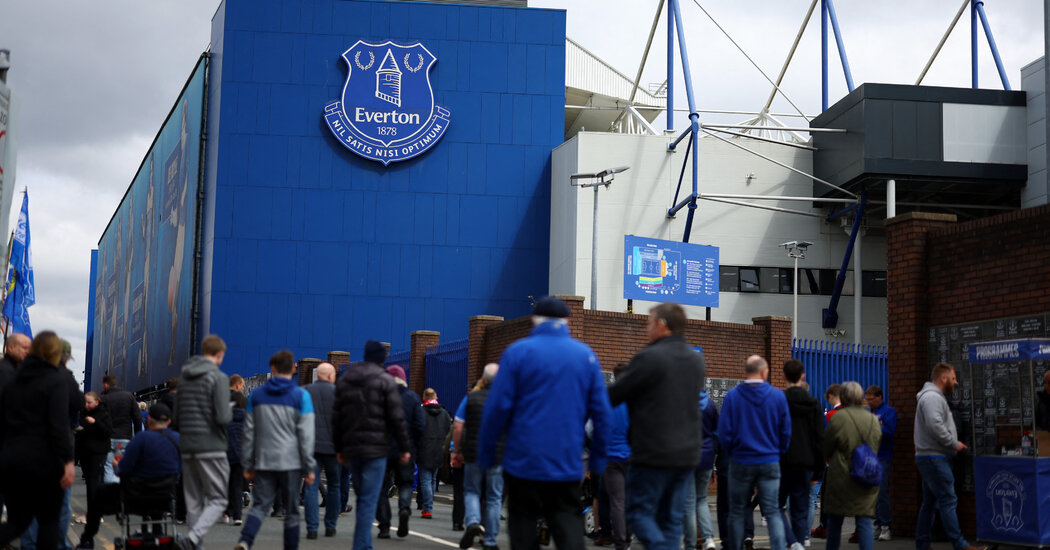
Everton Is Back on Market as Deal With 777 Partners Falters