

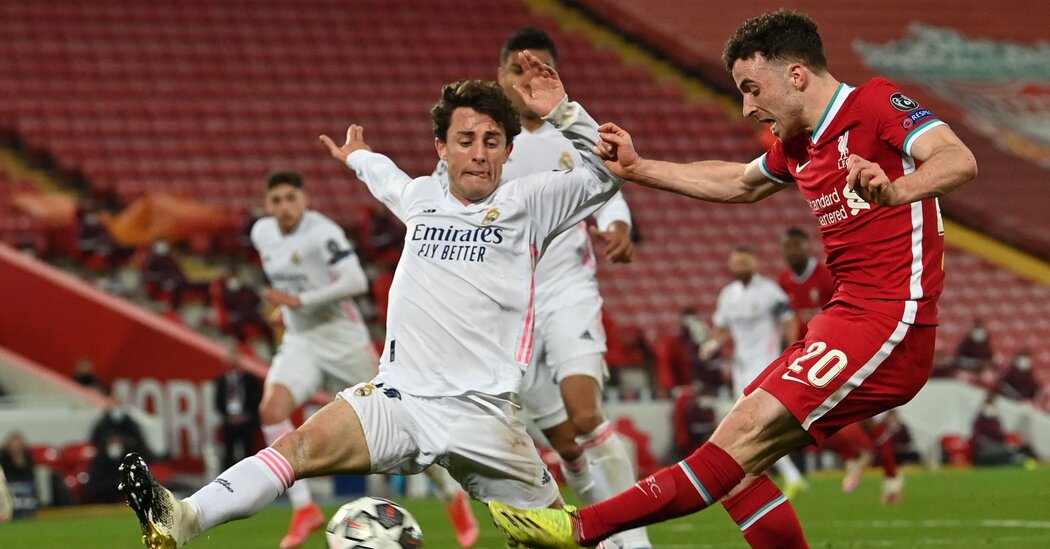
LONDON — A group of the world’s richest and most storied soccer clubs has agreed in principle on a plan to create a breakaway European club competition that would, if it comes to fruition, upend the structures, economics and relationships that have bound global soccer for nearly a century.
After months of secret talks, the breakaway teams — which include Real Madrid and Barcelona in Spain; Manchester United and Liverpool in England; and Juventus and A.C. Milan in Italy — were poised to make an announcement about their plans as early as Sunday, according to multiple people familiar with the plans.
The so-called super league they have agreed upon — an alliance of top clubs closer in concept to closed leagues like the N.F.L. and the N.B.A. than soccer’s current model — would bring about the most significant restructuring of elite European soccer since the 1950s, and could herald the largest transfer of wealth to a small set of teams in modern sports history.
In its current form, European soccer supplements domestic league play — an English league for English teams, a Spanish one for Spanish clubs — with Continental competitions between the best clubs. The most prestigious of those, the Champions League, brings together the best teams from each domestic league each year to play for the title of Europe’s, and arguably the world’s, best club.
The current system funnels hundreds of millions of dollars of annual television and sponsorship revenue to the world’s richest clubs, who supplement their domestic revenue with multimillion-dollar payouts from the Champions League. But the format also sustains smaller teams in each country, who benefit from the gloss of their encounters with the giants and share in the money those teams bring in from broadcasters.
The new super league model would change that, by stripping the Champions League of its most attractive and most successful teams and effectively walling off the richest clubs in their own closed competition — and allowing them to split the billions of dollars in annual revenue among themselves. According to projections shared with prospective clubs earlier this year, each of the teams could earn more than $400 million just for taking part — more than four times what the Champions League winner took home in 2020.
At least 12 teams have either signed up as founding members or expressed interest in joining the breakaway group, including six from England’s Premier League, three from Spain’s top division and three from Italy’s, according to the people with knowledge of the plan.
European soccer officials moved quickly to try to block the new league. The Premier League condemned the concept in a statement on Sunday and also sent a letter to its 20 member clubs warning them not to take part. Its top officials and their counterparts in Spain and Italy held emergency board meetings on Sunday.
Officials at European soccer’s governing body, UEFA, which runs the Champions League, labeled the proposal for a closed super league a “cynical project” in a statement. The missive was co-signed by the Premier League, La Liga in Spain and Italy’s Serie A, as well as the soccer federations of each country.
But UEFA was taking the threat seriously. Its leaders spent the weekend in discussions about how to block the plan, including banning the breakaway teams from their domestic leagues and blocking their players from competing for their national teams in events like the World Cup. European officials also pointedly reminded the prospective super-league clubs (and, effectively, their players) that soccer’s global governing body, FIFA, has backed their threats of expulsion.
“We will consider all measures available to us, at all levels, both judicial and sporting in order to prevent this happening,” the UEFA statement said. “Football is based on open competitions and sporting merit; it cannot be any other way.”
At the same time, soccer officials also began contacting lawmakers at the European Union, hoping the bloc would be able to strengthen its hand in preserving the status quo. Politicians in France and England quickly signaled their opposition to the plans.
The teams committed to the super league are, for the moment, limited to a dozen clubs from Spain, Italy and England. A cohort of six teams from the Premier League — United, Liverpool, Manchester City, Arsenal, Chelsea and Tottenham — represents the biggest grouping from a single country. Atlético Madrid is the other team from Spain that is said to have endorsed the project, while the Milan rivals Internazionale and A.C. Milan would join Juventus as Italy’s representatives.
The leaders of the breakaway group have been trying to get other top teams, like Germany’s Bayern Munich and Borussia Dortmund and the French champion Paris St.-Germain, to commit. But to date those clubs — and others — have declined to walk away from the domestic structures and Continental competitions that have underpinned European soccer for generations.
Their concerns can be both political and financial. P.S.G.’s president, Nasser al-Khelaifi, sits on the UEFA board, for example, and also heads beIN Media Group, the Qatar-based television network that has paid millions of dollars for the broadcast rights to games in the Champions League and various domestic competitions.
The New York Times contacted a number of clubs involved in the breakaway plans but all declined to comment or did not respond. The Premier League wrote to its 20 clubs after its board meeting on Sunday, though, warning the teams that the league’s rules bar clubs from joining outside competitions without approval.
“This venture cannot be launched without English clubs and we call upon any club contemplating associating themselves or joining this venture to walk away immediately before irreparable damage is done,” it said in a letter to the teams.
The timing of Sunday’s news appeared designed to overshadow UEFA’s plan to ratify a newly designed Champions League on Monday. That competition would be decimated by the departure of its biggest teams.
The repercussions of a split between European soccer and its best-known, best-followed and most deep-pocketed clubs would be seismic. Without the top teams, UEFA and the domestic leagues would face demands for millions of dollars in refunds from the broadcasters who pay billions for television rights to air their tournaments. The clubs left out would face a serious blow to their budgets while many are still wrestling with the financial wreckage caused by the coronavirus pandemic. And any ban on national team play would affect players individually, even if they had no role in the decision-making.
Among the most notable teams involved in the breakaway group is Juventus, the serial Italian champion. Its chairman, Andrea Agnelli, is a member of UEFA’s executive board and also leads the European Club Association, an umbrella body for more than 200 top division clubs, the majority of which will be left out of the proposed Super League.
When asked by The Times this year to discuss his role in the talks of a breakaway league, Agnelli brushed off the idea as a “rumor.”
Still, according to documents reviewed by The Times in January, plans for the breakaway league had gathered pace since last summer. Top clubs sought to take advantage of uncertainty in the soccer industry caused by the pandemic to forge a new path that would ensure a degree of financial stability for them but would also almost certainly lead to a significant — and potentially devastating — loss in value and revenue for the teams excluded from the project.
Each of the would-be permanent members of the proposed super league is being promised 350 million euros, or $425 million, to sign up, the documents said. The group leading the effort had entered into discussions with JPMorgan Chase to raise financing for the project, according to people with knowledge of the matter. The firm has so far declined to comment.
Under the proposals reviewed at the time, the super league, which would play its matches in the middle of the week, sought to secure 16 top soccer teams as permanent members and to add four qualifiers from domestic competitions. The clubs would be split into two groups of 10, with the top four teams in each group qualifying for the knockout stages, culminating in a final that would take place on a weekend.
Weekends would be reserved for domestic league matches, as they currently are, under the assumption that those leagues would not follow through on threats to expel their biggest teams.
Earlier this year, UEFA found a powerful ally in opposition to the plans in FIFA, which warned that any player who took part in such an unsanctioned league would be banned from appearing in any of its tournaments, including the World Cup. The statement came after UEFA’s president, Aleksander Ceferin, demanded support from his FIFA counterpart, Gianni Infantino, amid mounting speculation that the breakaway group had FIFA’s support.
By Sunday night, even the alliance of clubs led by Juventus’s Agnelli, the E.C.A., appeared to reject his idea.
Significant hurdles to the plan’s implementation remain. As member-owned clubs, Barcelona and Real Madrid would likely require the support of the thousands of their supporters before formally joining, and any German clubs that agree to take part would face similar obstacles. All can expect heavy internal opposition, too; fan groups from across Europe have consistently opposed even the idea of a closed super league.
On Sunday, one umbrella fan group, Football Supporters Europe, called the super league idea “illegitimate, irresponsible, and anti-competitive by design.”
“More to the point, it is driven exclusively by greed,” the group said. “The only ones who stand to gain are hedge funds, oligarchs, and a handful of already wealthy clubs, many of which perform poorly in their own domestic leagues despite their inbuilt advantage.”
24World Media does not take any responsibility of the information you see on this page. The content this page contains is from independent third-party content provider. If you have any concerns regarding the content, please free to write us here: contact@24worldmedia.com

The Biden administration on Wednesday canceled...
Every family has its archetypes, so here’s...
On March 7, 2024,1 Dr. Naomi Wolf sounded an...
There are many benefits to buying and consuming...
On a December morning in central London, more...
In the 10 years since the drugmaker Gilead...

Bill Harris: Omega-3 – A Simple Way to Lower Your Risk of Disease

Chasing a hockey dream together: How Luke and Sophia Kunin make the first NHL-PWHL marriage work

Why Constipation Is on the Rise

‘To the Future’: Saudi Arabia Spends Big to Become an A.I. Superpower

Antidepressants: What to Know About Uses and Side Effects

Is Eating Eggshells Beneficial?

How hockey helped make J.J. McCarthy one of NFL Draft’s most intriguing prospects

Aspartame Classified as 'Possibly Carcinogenic'

Why You Want More Carbon Dioxide
Mark Clattenburg: The celebrity referee turned PGMOL agitator… via Gladiators
Everton Is Back on Market as Deal With 777 Partners Falters