

Oct. 4, 2021, 3:40 p.m. ET
Oct. 4, 2021, 3:40 p.m. ET
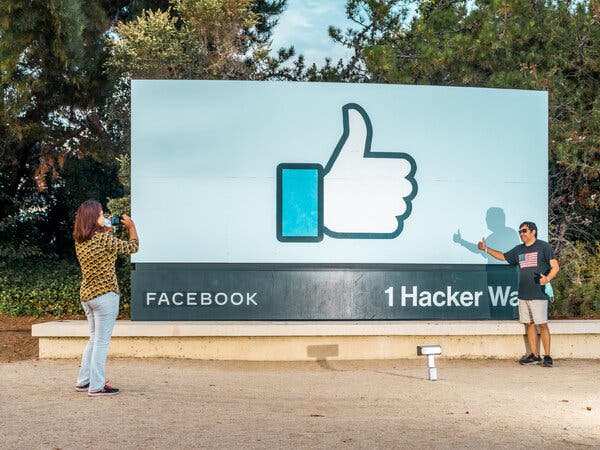
SAN FRANCISCO — Facebook and some of its apps, including Instagram and WhatsApp, appeared to go down at the same time on Monday for many users, who turned to Twitter and other social media platforms to lament the outage.
The social network and its apps began displaying error messages before noon Eastern time, users reported. All of the company’s family of apps — Facebook, Instagram, WhatsApp and Facebook Messenger — showed outage reports, according to the site downdetector.com, which monitors web traffic and site activity.
Outages are not uncommon for apps, but to have so many interconnected apps at the world’s largest social media company go down at the same time is rare. The company has been trying to integrate the underlying technical infrastructure of Facebook, WhatsApp and Instagram for several years.
Two Facebook security team members, who spoke on condition of anonymity because they were not authorized to speak publicly, said it was unlikely that a cyberattack caused the issues. That’s because the technology behind the apps was still different enough that one hack was not likely to affect all of them at once.
In a series of tweets, John Graham-Cumming, the chief technology officer of Cloudflare, a web infrastructure company, said the problem was likely with Facebook’s servers, which were not letting people connect to its sites like Instagram and WhatsApp.
Computers convert websites such as facebook.com to numeric internal protocol addresses, through a system that is likened to a phone’s address book, Mr. Graham-Cumming said. Facebook’s issue was the equivalent of removing people’s phone numbers from under their names in their address book, making it impossible to call them, he said. Cloudflare provides some of the systems that support Facebook’s internet infrastructure.
Andy Stone, a Facebook spokesman, posted on Twitter, “We’re aware that some people are having trouble accessing our apps and products. We’re working to get things back to normal as quickly as possible, and we apologize for any inconvenience.”
On Twitter, the hashtag #facebookdown quickly started trending. Some users said they were miffed by the abrupt outage, while others poked fun at it.
Instagram and Facebook are currently not working, as are democracy, society and a healthy sense of self.
— God (@TheTweetOfGod) October 4, 2021
Facebook’s internal communications platform, Workplace, was also taken out, leaving most employees unable to do their jobs. Two Facebook workers called it the equivalent of a “snow day.”
Facebook has already been dealing with plenty of scrutiny. The company has been under fire from a whistle-blower, Frances Haugen, a former Facebook product manager who amassed thousands of pages of internal research and has since distributed them to the news media, lawmakers and regulators. The documents revealed that Facebook knew of many harms that its services were causing.
Ms. Haugen, who revealed her identity on Sunday online and on “60 Minutes,” is scheduled to testify on Tuesday in Congress about Facebook’s impact on young users.
Ryan Mac contributed reporting.
This is a developing story and will be updated.
Facebook filed a motion on Monday to dismiss the Federal Trade Commission’s revised antitrust lawsuit against the company, saying the agency’s complaint still lacked evidence that the company had violated antitrust laws.
In a filing to the U.S. District Court for the District of Columbia, Facebook said the agency failed to provide adequate evidence and analysis that the company had a monopoly and harmed rivals through its dominant position. The judge overseeing the case, James E. Boasberg, said in June that the agency had not established Facebook as a monopoly in its original lawsuit but gave the agency a chance to amend its complaint with a stronger analysis.
“This court gave the agency a second chance to make a valid claim,” the company said in its filing. “But the same deficiency that was fatal to the F.T.C.’s initial complaint remains: the amended complaint still pleads no facts plausibly establishing that Facebook has, and at all relevant times had, monopoly power.”
Facebook’s motion to dismiss the case was widely expected. The company’s chief executive, Mark Zuckerberg, has promised to fight any government attempt to hobble the company through antitrust action.
The F.T.C., under the new leadership of Lina Khan, refiled the case in August with the same broad arguments and with some more analysis on market share and how Facebook used mergers with Instagram and WhatsApp to “buy or bury” competition. The agency also alleged that Facebook blocked rival apps from plugging into the Facebook platform, starving competition from accessing Facebook’s vast user base. The agency said in its suit that Facebook should be broken up.
The judge has until mid-November to respond to the company’s motion to dismiss the case.
Frances Haugen on Sunday revealed that she was the person who has loudly blown the whistle on Facebook. Until she left in May, she was a product manager on the social network’s civic misinformation team.
She amassed a trove of documents and used them to expose how much the company knew about the harms that it was causing and provided the evidence to lawmakers, regulators and the news media.
The spotlight on Ms. Haugen is set to grow brighter. On Tuesday, she is scheduled to testify in Congress about Facebook’s impact on young users.
In an interview with “60 Minutes” that was broadcast on Sunday night, Ms. Haugen, 37, said, “I’ve seen a bunch of social networks and it was substantially worse at Facebook than what I had seen before.” She added, “Facebook, over and over again, has shown it chooses profit over safety.”
Ms. Haugen gave many of the Facebook documents to The Wall Street Journal, which last month began publishing the findings. The revelations — including that Facebook knew Instagram was worsening body image issues among teenagers and that it had a two-tier justice system — have spurred criticism from lawmakers, regulators and the public.
She has also filed a whistle-blower complaint with the Securities and Exchange Commission, accusing Facebook of misleading investors on various issues with public statements that did not match the company’s internal actions.
Ford Motor said Monday that its sales of new vehicles in the United States fell about 27 percent in the three months that ended in September from the same period a year earlier. The drop was in line with the rest of the auto industry, which has been hampered by a global shortage of computer chips.
Ford was forced to idle many of its plants for parts of August and September because it did not have enough electronic parts that use computer chips to control components such as engines, transmissions and displays. The disruptions left dealers with few cars and trucks to sell.
In the quarter, Ford sold about 400,000 light trucks and cars, down from about 550,000 a year ago. General Motors on Friday reported that its third quarter U.S. sales fell 33 percent. Honda’s sales fell 11 percent and Chrysler’s 19 percent. Toyota reported its sales rose slightly during the quarter, but its total for September declined 22 percent.
But Ford said the supply of parts was improving, as was its inventory of new cars and trucks. It reported having 235,700 cars at the end of September, up from 162,100 at the end of June.
Ford’s lowered sales total resulted in a rare setback. It ranked fourth in U.S. sales in the quarter, trailing Toyota, G.M., and Stellantis, the company formed by the merger of Fiat Chrysler and France’s Peugeot SA.
Stocks on Wall Street dipped on Monday, as shares of big technology companies again tumbled. The S&P 500, the benchmark U.S. index, was down 1.7 percent, while the Nasdaq composite dropped 2.6 percent.
Apple, Amazon, Google and Microsoft were about 3 percent lower, while Facebook was off 5.6 percent. The biggest tech companies have enormous sway on the S&P 500 and Nasdaq.
The S&P 500 has fallen more than 5.5 percent since its Sept. 2 record, as investors have weighed concerns about the continuing disruptions to the economy and supply chains by the Delta variant and the effects of political brinkmanship on the economy. The Federal Reserve has also signaled that it was all but certain to start cutting back — or tapering — the $120 billion in new money it has been pouring into markets every month since the pandemic hit.
“You’ve had a market that has been heavily reliant on this overflowing bowl of stimulus,” said Edward Moya, a senior market analyst at Oanda, a foreign currency exchange and brokerage firm. “I think the market is really going to struggle once it loses its fix.”
Oil prices rose on Monday, with West Texas Intermediate, the U.S. crude benchmark, up 2.9 percent to $78.10 a barrel, its highest price since 2014. Officials from OPEC, Russia and other oil producers met Monday and decided to stick with their previous agreement to only gradually add oil to the market despite rising demand for energy. Shares of Devon Energy Corporation were up 5.9 percent, while Diamondback Energy rose 4.6 percent.
On Sunday, Frances Haugen, a former Facebook employee who is scheduled to testify before Congress on Tuesday, appeared on “60 Minutes” to discuss the social media giant’s business practices. “Facebook, over and over again, has shown it chooses profit over safety,” Ms. Haugen said on the program.
Adding to the social media giant’s losses, Facebook and some of its apps, including Instagram and WhatsApp, appeared to go down on Monday for many users.
A Senate vote on the stand-alone bill that would lift the statutory limit on federal borrowing until December 2022 is expected to fail amid a Republican filibuster. Janet Yellen, the Treasury secretary, told Congress that the deadline was Oct. 18 and inaction would risk a default on the federal debt.
Shares of China Evergrande were suspended on Hong Kong’s stock exchange on Monday after reports of a “major transaction.” The real estate developer has been under close watch by foreign investors after it missed two important interest payments on U.S. dollar bonds.
European stock indexes were lower, with the Stoxx Europe 600 down 0.5 percent.
Oil prices hit their highest levels since 2014 as officials from OPEC, Russia and other oil producers decided on Monday to stick with their previous agreement to only gradually add oil to the market. The announcement came despite rising demand for energy as businesses around the world resumed operations.
The 23-member group, known as OPEC Plus, said in a terse news release that it would raise production by a modest 400,000 barrels a day in November, less than 0.5 percent of world demand, under a deal reached in July.
In effect, the group shrugged off political and commercial pressure to ramp up oil production to ease a tightening market.
“It’s going to take oil prices sustaining above $80 a barrel for a period of time or pushing sharply higher” for the Organization of the Petroleum Exporting Countries to consider changing its plan, said Richard Bronze, head of geopolitics at Energy Aspects, a research firm.
Oil prices climbed on the news. West Texas Intermediate, the American standard, leapt to about $78 a barrel, its highest level since late 2014, while Brent crude, the international benchmark, was up nearly 3 percent to $81.56 a barrel. Oil prices have more than doubled in a year.
So far, analysts say, recent increases in the price of oil have not been sufficient to knock OPEC Plus off the course it worked out in July. In addition, prices at these levels are probably a pleasant surprise for the oil producers.
“There are squalls around, but they don’t want to rock the boat,” said Bhushan Bahree, a senior director at IHS Markit, a research firm.
OPEC Plus did little to explain its reasoning. The group said it was “acting in view of current oil market fundamentals.”
Analysts say the group is more cautious in its outlook than some industry observers who see demand for oil far outstripping supply in the months ahead. Consumption of oil has recovered strongly after crashing 9 percent last year, but the pandemic remains a concern in key oil consuming nations, including the United States.
With oil prices recovering, OPEC and its allies most likely saw little reason to reopen the agreement reached through long and difficult negotiations in July. That deal calls for gradual monthly output increases of 400,000 barrels per day well into next year.
OPEC Plus plans to meet each month to review the plan in case it needs adjusting.
A change of course might have encountered opposition, and it might have provided an opening for new negotiations on quotas from producers that would like higher ceilings — something that Prince Abdulaziz bin Salman, the Saudi oil minister, who leads these meetings, most likely wanted to avoid.
On the other hand, pressures to open the taps are growing. Signs of distress are emerging in the energy markets.
Already a global crunch in natural gas — a key fuel for generating electric power — threatens to affect oil prices. British consumers have faced several days of disruption because of a shortage of gasoline that is being blamed on a lack of fuel truck drivers.
Damage caused by Hurricane Ida in August to oil and gas infrastructure in the Gulf of Mexico has negated some of the impact of recent production increases by OPEC Plus.
A price jump to $90 a barrel or more might throw cold water on demand for oil and prompt a political backlash, including from the United States, some analysts say.
OPEC Plus could face louder calls for bigger increases at the group’s next meeting, which is scheduled for Nov. 4.
States and cities that have been slow to distribute emergency rental assistance funds will have to submit improvement plans or face the prospect of having the money redistributed to other places next month, the Treasury Department said Monday.
The Biden administration has been trying to get the $46.5 billion of relief funds flowing faster amid the recent expiration of a federal moratorium on evictions. Through August, just $7.7 billion has been distributed, and the Treasury Department is now essentially telling local governments to use it or lose it.
In a letter to officials across the country, Wally Adeyemo, the deputy Treasury secretary, said that some grant recipients had not done enough to distribute the money and that, in some cases, states and cities had gotten more money than they needed.
Treasury is giving local officials a chance to develop improvement plans and adopt the department’s recommendations for doling out the funds more quickly. States and cities that are responsible for disbursing the funds must show that they have obligated at least 65 percent of the money that they received or that they have already distributed 30 percent of the money to eligible households.
The Treasury Department will begin clawing back funds and reallocating the money on Nov. 15.
A Treasury official said the prospect of losing the funds had led states and cities to pick up the pace of getting the money out the door. The department will aim to reallocate to jurisdictions within states that have been using it most effectively and that are most in need, the official said.
transcript
transcript
With two quarters of trade and G.D.P. data for 2021 already in hand, it has become clear that the pace of trade recovery is closer to our optimistic scenario from March. This has led the W.T.O. to upgrade its projections for merchandise trade in 2021 and 2022. Our economists now estimate that the volume of world merchandise trade will increase by 10.8 percent in 2021, and then by 4.7 percent in 2022. These upward revisions to our merchandise trade numbers are good news, but not cause for complacency about the global economy or the multilateral trading system. The trade recovery is strong but unequal, mirroring the K-shaped recovery in global economic output. Some regions, those with access to vaccines and sufficient fiscal space are recovering strongly, while poorer regions with mostly unvaccinated populations are lagging behind. Moreover, the risks to the outlook are firmly on the downside. The pandemic itself is far from over, and new outbreaks and variants of Covid-19 could weigh on trade and output through 2022.

Global trade recovered from its pandemic lows faster than anticipated in the first half of 2021 and is set to grow more quickly than expected next year, lifting global growth forecasts, the World Trade Organization said Monday.
The W.T.O. now forecasts global merchandise trade to grow 10.8 percent in 2021, up from the 8 percent it forecast in March, as the flow of goods recovers from last year’s slump. Global trade is expected to rise 4.7 percent in 2022 as the growth rate approaches its prepandemic trend, the W.T.O. said.
That trade growth has not been equal as a result of the pandemic, the group said, with developing regions in particular lagging behind because of lower vaccination rates, and supply chain disruptions continuing to weigh on trade in some areas.
In remarks on Monday, Ngozi Okonjo-Iweala, the W.T.O. director general, said uneven access to vaccines was exacerbating an economic divergence across regions. She urged the group’s members to come together to agree on a foundation for more rapid vaccine production and equitable distribution.
“This is necessary to sustain the global economic recovery,” she said. “Vaccine policy is economic policy — and trade policy.”
More than six billion doses of the vaccine have been produced and administered worldwide, the W.T.O. said, but only 2.2 percent of people in low-income countries have received at least one dose.
Shares of China Evergrande were halted on Hong Kong’s stock exchange on Monday pending a deal, as doubts swirled over whether the struggling property giant would be able to meet its immense financial obligations.
Evergrande said in a filing that its shares were halted ahead of an announcement about a “major transaction.” It gave no additional details.
The real estate developer — once China’s most prolific — has been under close watch by foreign investors and local regulators after it missed two important interest payments on U.S. dollar bonds. The missed payments may not necessarily trigger a default because they each have a 30-day grace period before the missing payment would be considered a default.
Evergrande is under pressure from contractors and employees who are owed more than $300 billion in unpaid bills, as well as home buyers who are waiting on as many as 1.6 million unfinished apartments. In recent days, Wall Street banks and financial sleuths have been uncovering other liabilities that Evergrande may have in the form of guarantees that may add to its towering debt pile.
The company has not addressed its missed bond payments but said last week that it had sold a stake in a Chinese bank for $1.5 billion, which would go to pay some of its debts. Investors who are owed payments said they had not heard anything from the company, either.
Many of them have become increasingly pessimistic of a scenario where Beijing would step in to save Evergrande. It has hired restructuring experts to “explore all feasible options” for its future.
“I don’t expect payments will be made because the group has to be restructured,” said Michel Löwy, chief executive of SC Lowy, an investment firm that has a position in Evergrande bonds.
“I think it’s going to be a major hit for bondholders,” said Mr. Löwy, who said he was much more negative about the situation as more information has emerged about the quality of the land that Evergrande owns but has yet to develop. A restructuring of the entire sprawling real estate empire “would be very difficult to monetize,” he said.
Engine No. 1, the activist investment firm that made its name by successfully taking on Exxon Mobil, announced on Monday that it has taken a stake in General Motors. Unlike its bruising battle with Exxon, the purchase was pitched as a show of support for the automaker’s transition to electric vehicles.
G.M.’s stock rose by about 3 percent in early trading.
Activist investors more often take a stake in a company to lobby for management to make changes, not to endorse its strategy. Engine No. 1’s move also provides investors new information about how the upstart firm, which promotes its green credentials, values companies, at a time when corporate America is incorporating social and environmental factors into traditional financial measures.
In a white paper released ahead of the automaker’s investor day on Wednesday, Engine No. 1 argued that G.M. merited a higher valuation because of its scale and the commitments it had made to shifting to electric cars.
G.M.’s market capitalization is $77 billion, or about a tenth the value of Tesla’s.
“With General Motors, you have a management team and a board who has decided to really go all in on E.V.s — and to actually be a disrupter within their own industry,” Engine No. 1’s founder, Chris James, told the DealBook newsletter.
In January, G.M. became the first traditional auto company to commit to selling only zero-emission vehicles by 2035, an announcement that piqued Engine No. 1’s interest. The carmaker plans to spend $35 billion on electric and autonomous vehicles and build four battery plants in the United States by 2025.
Engine No. 1 first took a stake in G.M. in the first quarter. It declined to disclose the size of its position, but said it is among the three largest in its private fund. (The firm’s positions have been relatively small so far, including the stake it used to win board seats at Exxon.)
The firm has met informally with the carmaker’s management, including its chief executive, Mary Barra, and has no plans to start a proxy fight as it did at Exxon, Mr. James said.
“There is a very strong contrast here between the two companies,” Mr. James said, referring to Exxon and G.M. “A lot of it has to do with Mary, who is just a great leader, and having a board that is forward looking and willing to accept change and risk.”
Funding G.M.’s electric-vehicle initiatives has become trickier lately, as G.M.’s finances are dented by the semiconductor shortage. Electric vehicles also remain a small sliver of total U.S. auto sales, held back in part by a lack of charging stations, one of the many pieces of infrastructure in limbo amid congressional infighting.
“There are still challenges, unquestionably, and a supportive policy will move this faster,” Mr. James said. “But it’s now inevitable.”
OPEC meeting: The Organization of the Petroleum Exporting Countries and its allies are expected to review their oil output policy as energy prices soar. The cartel could revise its agreement to increase production each month by 400,000 barrels a day. Brent crude futures, the global benchmark, recently hit their highest level in almost three years.
Hollywood strike: The International Alliance of Theatrical Stage Employees, a union representing more than 150,000 TV and film production workers, could vote to authorize a strike. The union, which has been working without a contract since mid-September, is negotiating on issues including excessive hours and reduced pay on streaming projects.
Facebook hearing: A Facebook whistle-blower will testify at a Senate hearing about the company’s effect on young users. The hearing comes after The Wall Street Journal reported on internal company documents detailing Facebook’s research on the negative impact of its Instagram app on teenage girls and others.
Elizabeth Holmes trial: The fraud trial of the Theranos founder Elizabeth Holmes will head into its fifth week. So far, jurors have heard detailed technical accounts from former employees of the problems with Theranos’s blood tests, including that machines that failed quality control tests and delivered inaccurate results.
Levi Strauss earnings: The clothing retailer is set to report its financial performance for the quarter ending August. Investors are looking out for any signs of supply chain disruptions, which have plagued other retailers as factories in Vietnam and China have partially or completely shut down following coronavirus outbreaks and power outages.
Justice Department Nominee: Jonathan Kanter, President Biden’s appointee to lead the Justice Department’s antitrust division, will appear before the Senate Judiciary Committee for a confirmation hearing. Mr. Kanter’s critics are likely to question whether his previous work as a corporate lawyer against American tech giants is a conflict of interest that should keep him out of investigations into these companies.
Jobs report: The Labor Department is expected to release its monthly jobs report for September. The report for August showed a hiring slowdown. Economists are forecasting that the U.S. economy added 450,000 jobs during the month, a sharp gain from the 235,000 added in August but still below the growth rates seen earlier in the spring and summer.
The cryptocurrency industry has been up in arms over a tax-reporting provision in the infrastructure bill working its way through Congress.
The proposed bill defines a “broker” in a way that would apply to everyone involved in a crypto transaction, including software developers of decentralized finance platforms and Bitcoin miners. It is damaging and impractical to require these players to report tax data on users that they do not know, crypto advocates have argued.
A bug in a popular protocol’s code, discovered during a recent upgrade, has undermined the industry’s claims, the DealBook newsletter reports.
Last week, a flaw in the code of the automated money market protocol Compound, which has $15 billion in assets, led to tens of millions of dollars worth of its crypto token erroneously going to some users. Compound’s chief, Robert Leshner, tweeted that anyone who didn’t voluntarily return the money would be reported to the I.R.S., seemingly undermining claims that identifying users of decentralized crypto platforms like Compound is impossible.
“This episode shows that the current lack of tax reporting by major cryptocurrency platforms aren’t technological limitations,” said Alexis Goldstein of the Open Markets Institute. “They’re design decisions.”
Mr. Leshner said that his tweet was “misconstrued,” adding that anyone could identify the public Ethereum addresses that interact with the Compound protocol, and whether they engaged with popular exchanges like Coinbase that collect information about users. Mr. Leshner said he “intended to suggest” that given the likelihood of interaction with a centralized exchange, “anyone could point to which addresses received an unexpected windfall.”
The episode exposed the vulnerabilities of automated crypto financial systems, just as regulators, alarmed by the alternative ecosystems being built on the blockchain, plan to issue a series of reports this fall outlining new rules for the future of finance.
Do crypto’s benefits offset its considerable energy demands? The Times’s Andrew Ross Sorkin and the DealBook team evaluate the industry’s impact and look at innovations for a cleaner future.
Even as global warming melts the ice that covers 80 percent of Greenland, the world wants its potentially abundant reserves of hard-to-find minerals — so-called rare earths, used in wind turbines, electric motors and many other electronic devices, that are essential raw materials as the world tries to break its addiction to fossil fuels.
But mining projects have side effects, and proposals that threaten the environment or livelihoods may run into trouble from local people who are quite capable of standing up to powerful interests. READ THE ARTICLE →
“Anyone recognize him?” the police in Winter Haven, Fla., asked on Facebook last month in a post that included photos of a man walking out of a Walmart without paying for boxes of diapers and other items.
“When your card is declined and you try another one with the same result, that is NOT license to just walk out with the items anyway,” the police said in a Facebook post, which was later deleted.
The Winter Haven Police Department drew swift criticism for the post from people wondering why the department had gone after a man who had stolen basic necessities for his children, also pictured in the surveillance photos.
After the incident, which was previously reported by WFTS-TV in Tampa, Fla., the store asked the police not to prosecute the man, according to a waiver of prosecution the police department provided to The New York Times. Walmart and the man did not respond to requests for comment.
It’s possible the man was among the one in three American families who struggle with diaper need, according to a February 2020 report by the National Diaper Bank Network, an organization that provides diapers to children. Joanne Samuel Goldblum, the network’s founder and chief executive, said she suspects that figure probably rose during the coronavirus pandemic as diaper prices increased and supply plummeted.
“Diaper need is a topic that’s so swept under the rug,” she said. “Covid really laid it bare for us.”
The pandemic has upended global supply chains and created a run on many products, including diapers. Kimberly-Clark and Procter & Gamble, two of the country’s largest diaper manufacturers, increased the prices of baby products this year. A typical package of 100 diapers costs $30 to $50 from most online retailers.
Even a small price increase can put a strain on families, many of whom pay around $75 for a month’s worth of diapers for one baby, according to the National Diaper Bank Network. Many parents have to choose between buying diapers or other necessities, and some will leave their child in a soiled diaper because they can’t afford a replacement.
The United States will begin talks with China in the coming days as it tries to get Beijing to fulfill commitments it made in a trade deal signed during the Trump administration, Katherine Tai, the U.S. trade representative, said in a speech in Washington on Monday.
Ms. Tai said the United States would also use those talks to raise broader concerns about China’s nonmarket trade practices, including subsidies it provides to Chinese industries. And she made clear that the administration had no plans to immediately roll back the tariffs that President Donald J. Trump placed on Chinese goods, though she said the United States would establish a process for companies to qualify for special exclusions from the tariffs.
In remarks that laid out the first details on the administration’s approach to trade with China, Ms. Tai said she would use “the full range of tools we have” to defend American workers from China’s harmful policies. She also promised to work with allies and invest heavily in American capacity, including in job training and infrastructure, to better compete with China.
But she gave few policy specifics on what the United States would do beyond seeking to enforce the Phase 1 trade deal signed under Mr. Trump.
China is on pace to fall short of its 2021 purchasing commitments by more than 30 percent, after falling short by more than 40 percent last year, according to Chad P. Bown, a senior fellow at the Peterson Institute for International Economics, who tracks the purchases.
Ms. Tai gave a mixed review of Mr. Trump’s trade deal, saying it had focused on “longstanding and serious problems” like intellectual property violations and benefited some industries like U.S. agriculture. But she said it “did not meaningfully address the fundamental concerns that we have with China’s trade practices and their harmful impacts on the U.S. economy.”
She highlighted industries like steel, solar panels and semiconductors, where China has used generous government financing and state-directed purchases to corner global markets and squeeze American competitors.
“Those policies have reinforced a zero-sum dynamic in the world economy where China’s growth and prosperity come at the expense of workers and economic opportunity here in the U.S. and other market-based, democratic economies,” Ms. Tai said. “That is why we need to take a new, holistic and pragmatic approach in our relationship with China that can actually further our strategic and economic objectives — for the near-term and the long-term.”
Ms. Tai’s remarks appear to hint at the possibility of a future trade investigation into Chinese subsidies. The U.S. trade representative has been considering starting an investigation under a legal statute known as Section 301, according to people familiar with the deliberations, which could ultimately allow the United States to impose more tariffs or take other punitive actions.
When asked in a question-and-answer session if the United States would pursue a Section 301 investigation, Ms. Tai declined to say but said she would “look at all available tools.”
24World Media does not take any responsibility of the information you see on this page. The content this page contains is from independent third-party content provider. If you have any concerns regarding the content, please free to write us here: contact@24worldmedia.com

The Biden administration on Wednesday canceled...
Every family has its archetypes, so here’s...
On March 7, 2024,1 Dr. Naomi Wolf sounded an...
There are many benefits to buying and consuming...
On a December morning in central London, more...
In the 10 years since the drugmaker Gilead...

Bill Harris: Omega-3 – A Simple Way to Lower Your Risk of Disease


Chasing a hockey dream together: How Luke and Sophia Kunin make the first NHL-PWHL marriage work

Why Constipation Is on the Rise

‘To the Future’: Saudi Arabia Spends Big to Become an A.I. Superpower

Antidepressants: What to Know About Uses and Side Effects

Is Eating Eggshells Beneficial?

How hockey helped make J.J. McCarthy one of NFL Draft’s most intriguing prospects
Aspartame Classified as 'Possibly Carcinogenic'

Why You Want More Carbon Dioxide

Mark Clattenburg: The celebrity referee turned PGMOL agitator… via Gladiators
Everton Is Back on Market as Deal With 777 Partners Falters