

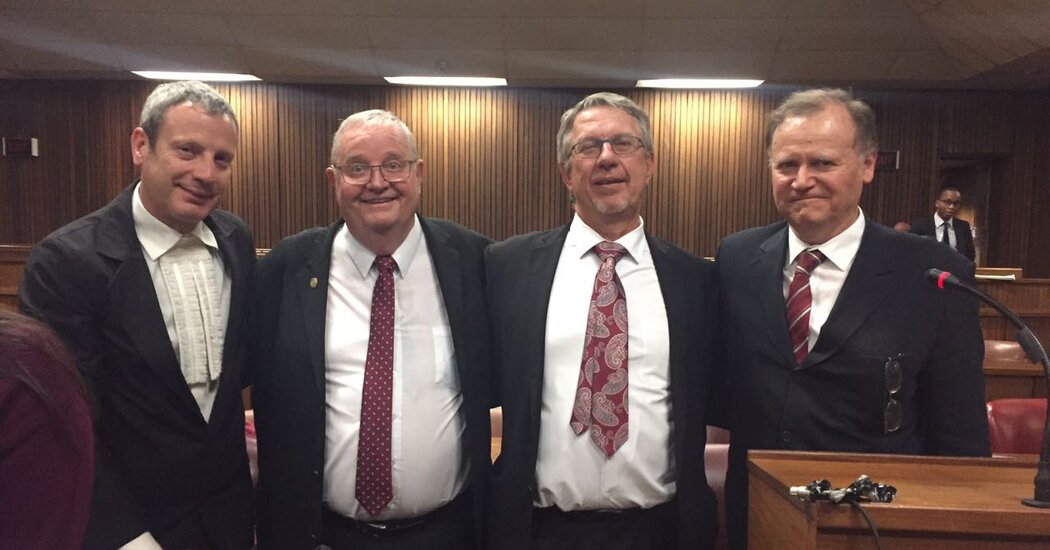
Mr. Dutton attended Boys’ Town, a school for troubled youth, in Magaliesburg, on the western outskirts of Johannesburg, and joined South Africa’s national police force in 1966. After a year of police college in Pretoria, he was deployed to Natal Province (known today as KwaZulu Natal).
Early on he developed a reputation as an assiduous cop unafraid to butt heads with an insular, self-protective leadership. He also stood out for his willingness to partner with Black officers, even in the face of overt discrimination: When he and Mr. Magadla went out of town on assignment, they would often sleep in a jail cell, for lack of a hotel that would accommodate both of them.
He later applied his investigative skills internationally. When Judge Goldstone was placed in charge of the United Nations’s investigation into war crimes in the former Yugoslavia in the late 1990s, he brought Mr. Dutton along — first, to examine mass graves in Bosnia, then as the lead investigator across the entire region.
After retiring from the police in 2003, Mr. Dutton worked as a consultant for the United Nations, a job that took him around the world, investigating sexual abuse in the Democratic Republic of Congo, human rights violations in East Timor and police corruption in the Seychelles.
In the 2010s, he joined Mr. Varney and a small team of lawyers, human rights activists and other investigators to reopen apartheid-era cold cases in which activists had died in police custody, their deaths officially ruled suicides.
The first case involved Ahmed Timol, a communist and A.N.C. member who died in 1971 after falling from a high floor of the main Johannesburg police station. A judge said he had committed suicide, despite evidence that he had been tortured. Thanks to Mr. Dutton’s work, the case was reopened, and in 2017 another judge ruled it a homicide by the police.
The next year, Mr. Dutton returned to investigating government corruption under former President Jacob Zuma as a part of the so-called Zondo Commission. At his death he was preparing to lead an investigation into the commission’s findings.
He was also awaiting a ruling in another high-profile apartheid-era cold case, involving the supposed suicide of Neil Aggett, a doctor and labor activist, in police custody in 1982. His death galvanized the anti-apartheid movement and helped set in motion a wave of activism in the 1980s. The ruling is expected in the coming weeks.
24World Media does not take any responsibility of the information you see on this page. The content this page contains is from independent third-party content provider. If you have any concerns regarding the content, please free to write us here: contact@24worldmedia.com

The Biden administration on Wednesday canceled...
Every family has its archetypes, so here’s...
On March 7, 2024,1 Dr. Naomi Wolf sounded an...
There are many benefits to buying and consuming...
On a December morning in central London, more...
In the 10 years since the drugmaker Gilead...

Bill Harris: Omega-3 – A Simple Way to Lower Your Risk of Disease
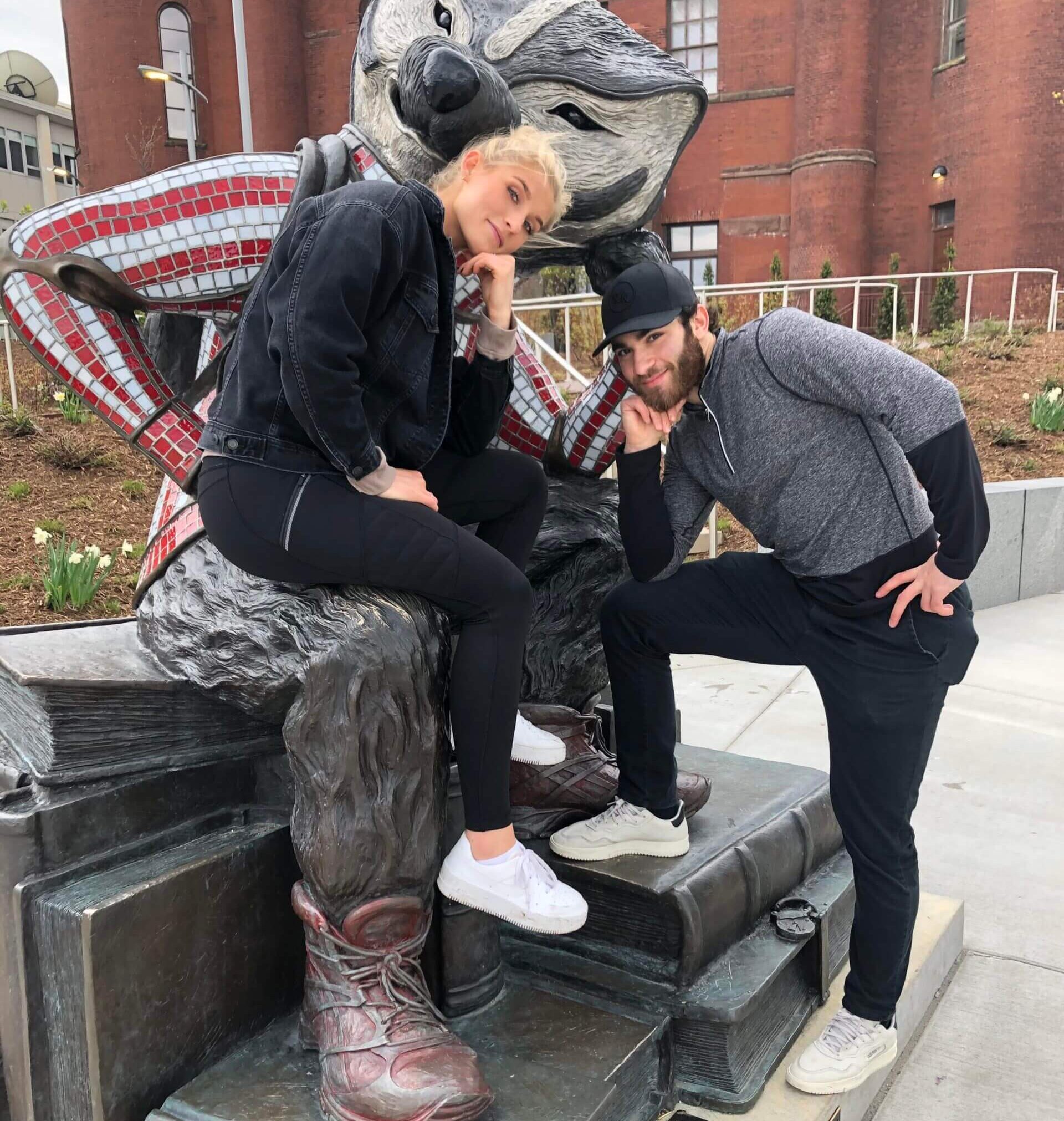
Chasing a hockey dream together: How Luke and Sophia Kunin make the first NHL-PWHL marriage work

Why Constipation Is on the Rise

‘To the Future’: Saudi Arabia Spends Big to Become an A.I. Superpower

Antidepressants: What to Know About Uses and Side Effects

Is Eating Eggshells Beneficial?

How hockey helped make J.J. McCarthy one of NFL Draft’s most intriguing prospects

Aspartame Classified as 'Possibly Carcinogenic'

Why You Want More Carbon Dioxide

Mark Clattenburg: The celebrity referee turned PGMOL agitator… via Gladiators
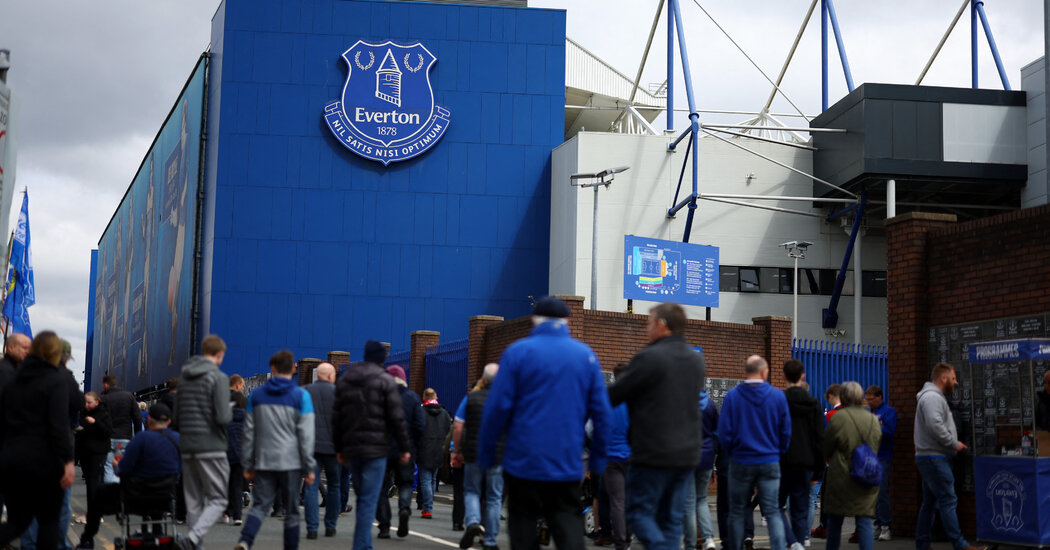
Everton Is Back on Market as Deal With 777 Partners Falters