

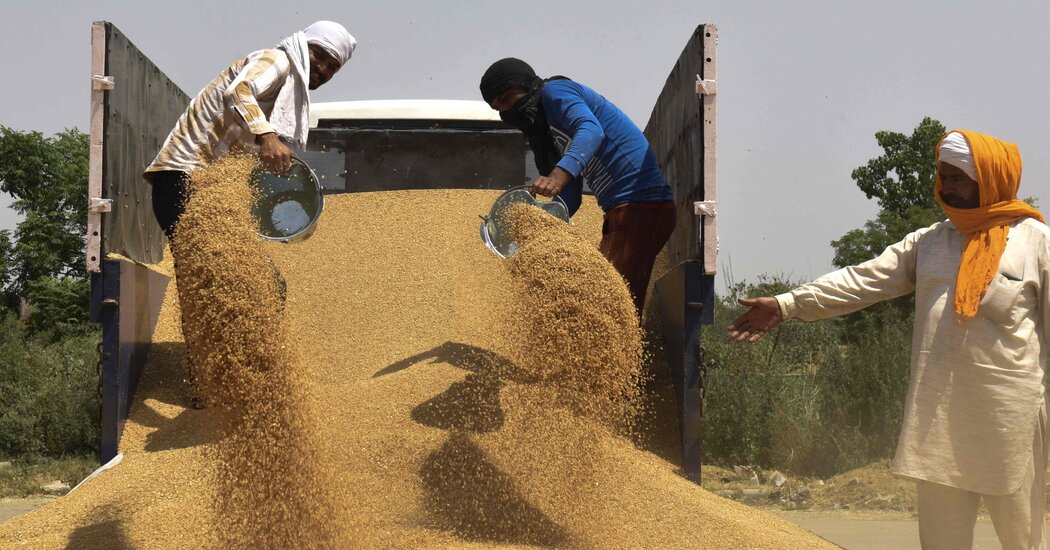
India, the world’s second-largest wheat producer, has banned exports of the grain with some exceptions, a move that could compound a worldwide shortfall worsened by the war in Ukraine and exacerbate an already dire forecast for hunger across the globe.
The war has interrupted wheat production in Ukraine and Russia, which are major suppliers. Fighting and blockades in the Black Sea have disrupted transport of the grain. And poor harvests in China, along with a heat wave in India and drought in other countries, have further snarled global supply.
India has about 10 percent of the world’s grain reserves, according to data from the United States Department of Agriculture, a large surplus resulting from its heavily subsidizing of its farmers. It has been seen for months as a country that could help make up for global supply shortages.
The wheat export ban, announced in a Commerce Ministry notice dated Friday, appeared to be an about-face from earlier statements from Prime Minister Narendra Modi. The Indian leader told President Biden in April that the country was ready to supply the world from its reserves. He also urged domestic wheat producers to seize the opportunity, saying that Indian officials and financial institutions should support exporters.
The Commerce Ministry notice on Friday said that wheat exports were immediately banned, with some exceptions, because a sudden spike in the crop’s price had threatened India’s food security. Limited exports will be allowed at the request of individual governments whose own food supply is vulnerable, the notice said.
The export ban could be a further blow to international organizations working to counter the increasing threat of widespread hunger. The World Food Program, a United Nations agency, has warned that an additional 47 million people could go hungry as the war’s ripple effects add to an existing crisis of steep increases in food prices and a fertilizer shortage.
In early May, the agency’s chief economist, Arif Husain, said that it was in discussions with India to tap into its stockpile to alleviate the shortage. He also said that the World Food Program had urged nations not to enact export bans because they could raise prices and reduce availability. “Hopefully, countries are listening,” he said.
Ashok Gulati, a prominent agricultural economist in India, said the ministry’s announcement reflected poorly on India, given that it contradicted the government’s previous comments about wanting to supply wheat to countries in need.
“If there is a global surge, you can tame it by opening, rather than closing down borders,” Mr. Gulati said.
The move is also likely to be unpopular among India’s farmers.
Ranbeer Singh Sirsa, a farmer in Punjab State, said the ban was likely to affect wheat farmers who had benefited recently from higher prices and demand.
“If the price wants to go up, let it settle at the international price,” Mr. Sirsa said. “Who are they trying to protect now, at the cost of farmers?”
24World Media does not take any responsibility of the information you see on this page. The content this page contains is from independent third-party content provider. If you have any concerns regarding the content, please free to write us here: contact@24worldmedia.com

The Biden administration on Wednesday canceled...
Every family has its archetypes, so here’s...
On March 7, 2024,1 Dr. Naomi Wolf sounded an...
There are many benefits to buying and consuming...
On a December morning in central London, more...
In the 10 years since the drugmaker Gilead...

Bill Harris: Omega-3 – A Simple Way to Lower Your Risk of Disease


Chasing a hockey dream together: How Luke and Sophia Kunin make the first NHL-PWHL marriage work

Why Constipation Is on the Rise

‘To the Future’: Saudi Arabia Spends Big to Become an A.I. Superpower

Antidepressants: What to Know About Uses and Side Effects

Is Eating Eggshells Beneficial?

How hockey helped make J.J. McCarthy one of NFL Draft’s most intriguing prospects

Aspartame Classified as 'Possibly Carcinogenic'

Why You Want More Carbon Dioxide

Mark Clattenburg: The celebrity referee turned PGMOL agitator… via Gladiators

Everton Is Back on Market as Deal With 777 Partners Falters