

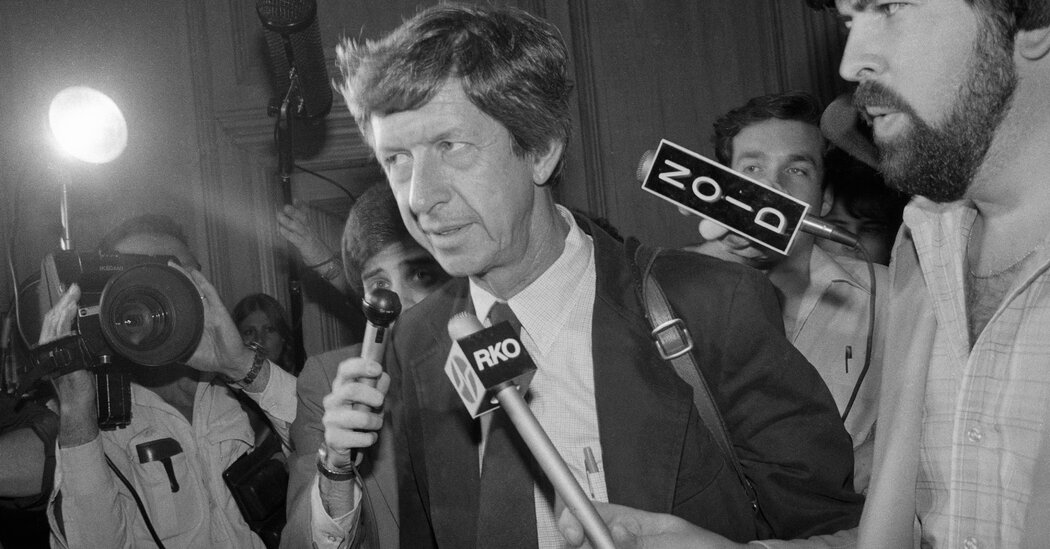
Mr. Moffett, who had dealt with the union since 1970, was not surprised by its defiance of Reagan.
“They thought that the government and the country could not exist without them acting,” Mr. Moffett said when Professor McCartin, who teaches history at Georgetown University, interviewed him for his book in 2001. “There are some people that are just not replaceable, per se, and they felt they were these guys.”
Kenneth Elwood Moffett was born on Sept. 11, 1931, in Lykens, Pa., north of Harrisburg. His father, Elwood, was a coal miner who rose to the presidency of District 50, a union of workers in fields related to coal mining that was part of the United Mine Workers and later the United Steelworkers of America. His mother, Hannah (Ely) Moffett, was a homemaker.
Unionism was ingrained in the Moffett family. A great-great-grandfather of Mr. Moffett’s was part of the Molly Maguires, a secret society of Irish American coal miners that battled mine owners in the 19th century. One of his grandfathers was active in the U.M.W. and died of black lung disease. And his father took him to labor meetings and to factories, where Ken handed out pamphlets to unorganized workers.
After graduating from the University of Maryland with a bachelor’s degree in physical education in 1958, Mr. Moffett worked as an organizer for District 50 in Baltimore and Richmond, Va. In 1961, he left for the federal mediation service as an intern. His job involved research; he later moved into mediating disputes in Cleveland for five years, then worked in Washington as a troubleshooter at the agency.
“I get along with people pretty well,” he told The Washington Post in late 1981, after his busy summer. “You can’t have someone doing this who’s acerbic.” He added, “I know all the catchwords and the key jargon which makes people say, ‘Hmm, he is being sympathetic.’”
He became the service’s director of mediation services in 1972, deputy director in 1977 and acting director four years later.
Even with his growing administrative responsibilities, Mr. Moffett remained active in mediating disputes, like the pressmen’s strike at The Washington Post in 1975 and the newspaper strike in New York City in 1978 that shuttered The New York Times and The Daily News for nearly three months and The New York Post for 56 days.
24World Media does not take any responsibility of the information you see on this page. The content this page contains is from independent third-party content provider. If you have any concerns regarding the content, please free to write us here: contact@24worldmedia.com

The Biden administration on Wednesday canceled...
Every family has its archetypes, so here’s...
On March 7, 2024,1 Dr. Naomi Wolf sounded an...
There are many benefits to buying and consuming...
On a December morning in central London, more...
In the 10 years since the drugmaker Gilead...

Bill Harris: Omega-3 – A Simple Way to Lower Your Risk of Disease

Chasing a hockey dream together: How Luke and Sophia Kunin make the first NHL-PWHL marriage work

Why Constipation Is on the Rise

‘To the Future’: Saudi Arabia Spends Big to Become an A.I. Superpower

Antidepressants: What to Know About Uses and Side Effects

Is Eating Eggshells Beneficial?

How hockey helped make J.J. McCarthy one of NFL Draft’s most intriguing prospects

Aspartame Classified as 'Possibly Carcinogenic'

Why You Want More Carbon Dioxide

Mark Clattenburg: The celebrity referee turned PGMOL agitator… via Gladiators

Everton Is Back on Market as Deal With 777 Partners Falters