

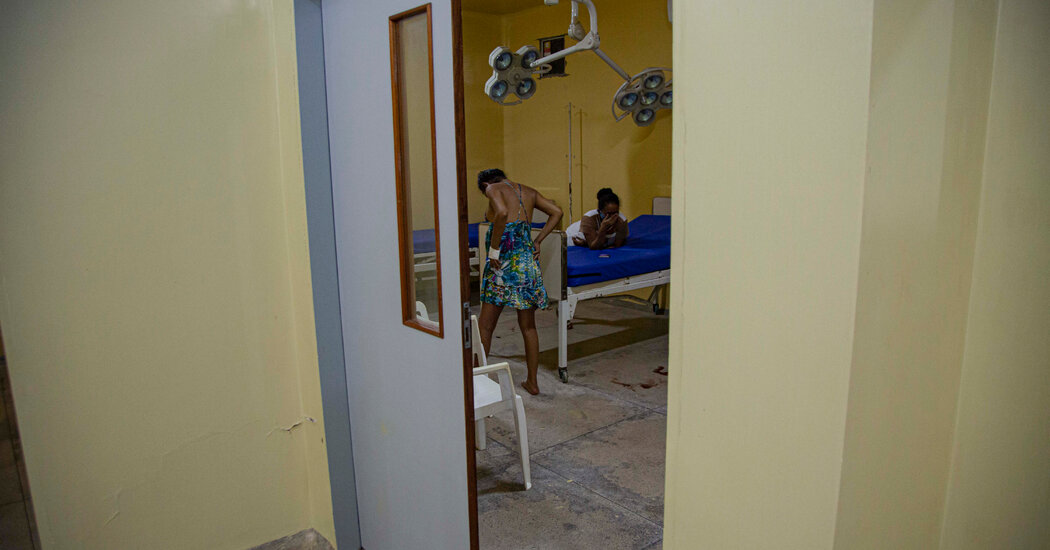
Medical school curriculums, for example, include erroneous claims that Black women’s nerve endings are “less sensitive” and require less anesthesia, and that Black women’s blood coagulates faster than that of white women, leading to delayed treatment for dangerous hemorrhages, according to the report. It also found that textbook illustrations of childbirth were depicted on European women’s pelvic anatomy, which could cause unnecessary interventions when nonwhite variability was deemed “abnormal or high-risk.”
“When a Black woman dies during childbirth, whether in São Paulo, Bogotá or New York, it’s often put down to her lifestyle or to individual failure: She didn’t get there in time to see the doctor or the nurse, she made poor life decisions, she was predisposed to certain medical conditions. And then the world moves on,” Dr. Kanem said.
The new report, she said, “categorically refutes that.”
The overall maternal mortality ratio of maternal deaths per 100,000 live births in Latin America, North America and the Caribbean increased by about 15 percent between 2016 and 2020, piquing officials’ interest in possible contributing factors, including race. There are more than 200 million people of African descent in the Americas — one in four people in Latin America and the Caribbean, and one in seven in the United States and Canada.
Among countries that provide maternal death rates by race, the United States has the lowest death rate overall, but the widest racial disparities. Black women in the United States are three times more likely than white women to die during or soon after childbirth. Those problems persist across income and education levels, as Black women with college degrees are still 1.6 times as likely to die in childbirth as white women who have not finished high school.
U.N. officials urged medical schools to re-examine their curriculums and hospitals to strengthen policies surrounding denial of care and patient abuse. Medical teams must also consider innovative ways to help Black women overcome structural barriers that make it difficult to receive sufficient prenatal care, officials said, such as a lack of access to reliable transportation and insurance. The agency suggested partnerships with various Black traditional healers and midwives to help navigate longstanding reservations.
The U.N. project also revealed a profound dearth of surveillance data, which has likely kept the problems from becoming well known, it said. The report encouraged every country to enhance its data collection efforts. Without a transparent look at the problem, the report said, it will be near impossible to design interventions to remedy it.
24World Media does not take any responsibility of the information you see on this page. The content this page contains is from independent third-party content provider. If you have any concerns regarding the content, please free to write us here: contact@24worldmedia.com

The Biden administration on Wednesday canceled...
Every family has its archetypes, so here’s...
On March 7, 2024,1 Dr. Naomi Wolf sounded an...
There are many benefits to buying and consuming...
On a December morning in central London, more...
In the 10 years since the drugmaker Gilead...

Bill Harris: Omega-3 – A Simple Way to Lower Your Risk of Disease

Chasing a hockey dream together: How Luke and Sophia Kunin make the first NHL-PWHL marriage work

Why Constipation Is on the Rise

‘To the Future’: Saudi Arabia Spends Big to Become an A.I. Superpower
Antidepressants: What to Know About Uses and Side Effects

Is Eating Eggshells Beneficial?

How hockey helped make J.J. McCarthy one of NFL Draft’s most intriguing prospects

Aspartame Classified as 'Possibly Carcinogenic'

Why You Want More Carbon Dioxide

Mark Clattenburg: The celebrity referee turned PGMOL agitator… via Gladiators

Everton Is Back on Market as Deal With 777 Partners Falters